Toilet & Fixture Overflow Cleanup in Rowlett, TX
Toilet overflowing? Turn off the valve behind the bowl, keep everyone off the wet floor, and call (555) 247-0199.
Toilet overflow cleanup in Rowlett starts once the water is stopped. We pump the water off your floor, check how far it went under the flooring and into the walls, and dry it until the meters read dry. Your plumber clears the clog or fixes the part. Call to confirm service for your address in ZIP codes 75088 and 75089.
Call (555) 247-0199 to request Toilet & Fixture Overflow Cleanup in Rowlett.
What should I do first when my toilet is overflowing?
Don’t flush again. If you can reach the valve behind the toilet from a dry spot, turn it clockwise until it stops. Keep kids and pets away from the wet area, and take photos from a dry spot before you clean anything. If reaching the valve means walking through standing water, stay out and call a plumber.
Don’t flush again
Every flush adds water to a bowl that is already full.
Shut off the supply
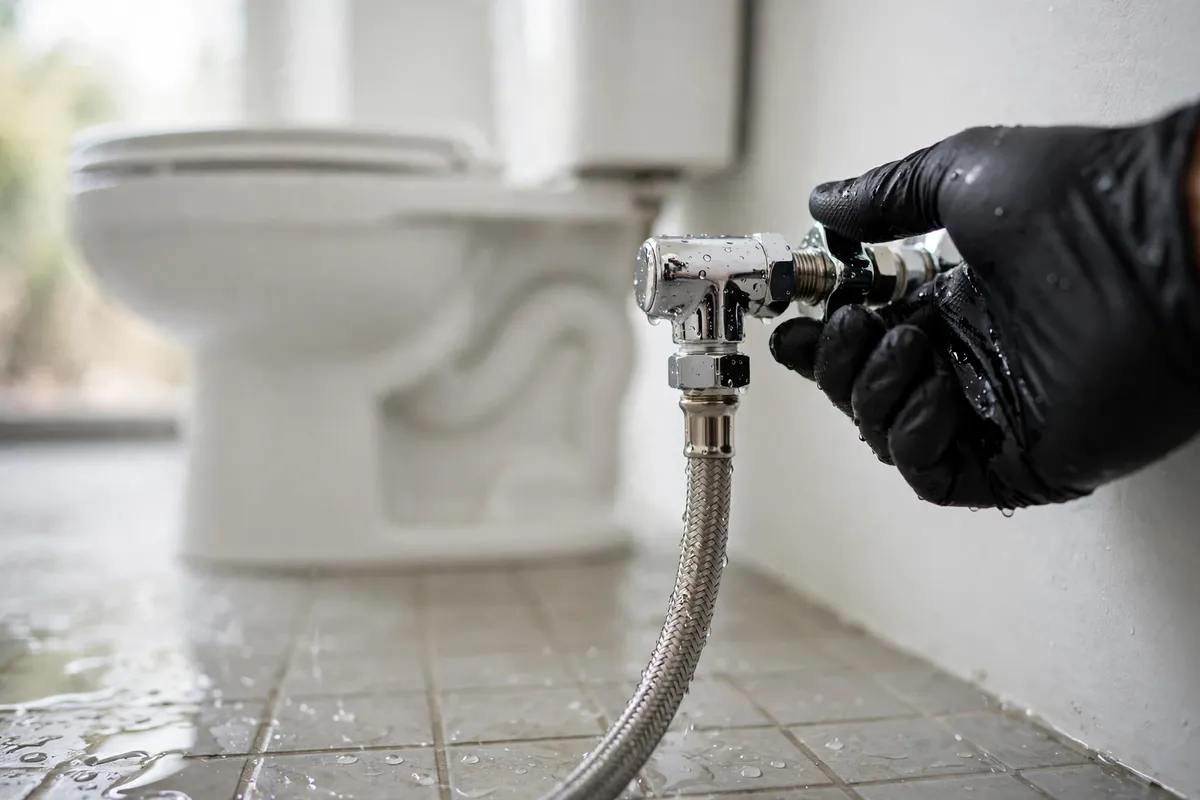
The valve behind the toilet is called the angle stop. Turn it clockwise. If it won’t close all the way, shut off the main water valve for the house.
Stop the tank, only if you can reach it dry
Take off the tank lid and push the flapper down or lift the float. That stops the fill while you work on the valve.
Contain it
Lay towels on the dry side of the doorway so the water doesn’t walk into the hall. Don’t step into the wet area to do it.
Mind the power
If water is near outlets, turn power off only from a dry spot. If you would have to cross standing water to reach the panel, stay out and call an electrician.
Photograph and video
The floor, the waterline and the toilet. The Texas Department of Insurance (TDI) says to take pictures before repairs.
Make two calls
A plumber for the clog or the part, and us for the water.
What should I not do?
- Don’t pour chemical drain opener into the bowl. It rarely clears a toilet and leaves harsh water for whoever plunges next, ARO Restorations and Piping Craft both warn.
- Don’t wade in barefoot. For sewage, the CDC says to wear rubber boots, rubber gloves and goggles, so treat bowl water the same way.
- Don’t throw damaged items out until you have photographed them and asked your adjuster how to document contaminated items before disposal.
- Don’t keep flushing to test the toilet. Wait for the plumber.
What does Toilet & Fixture Overflow Cleanup include?
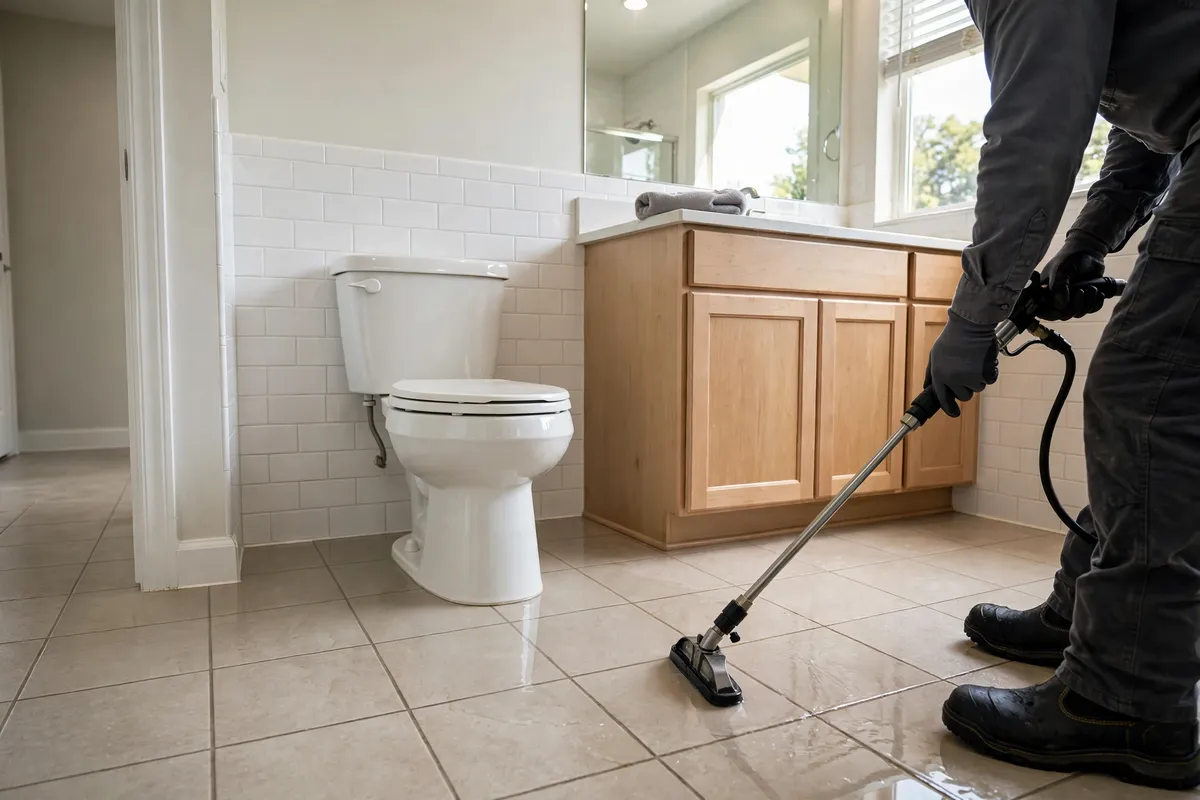
Toilet & Fixture Overflow Cleanup means checking the water type, mapping the moisture, pumping out the water, removing what can’t be saved, washing and disinfecting, then drying to dry readings. The crew takes photos and moisture readings, and you can ask for copies for your adjuster.
Assess the source and safety. The crew confirms the water is off, checks for electrical hazards and sets the water category.
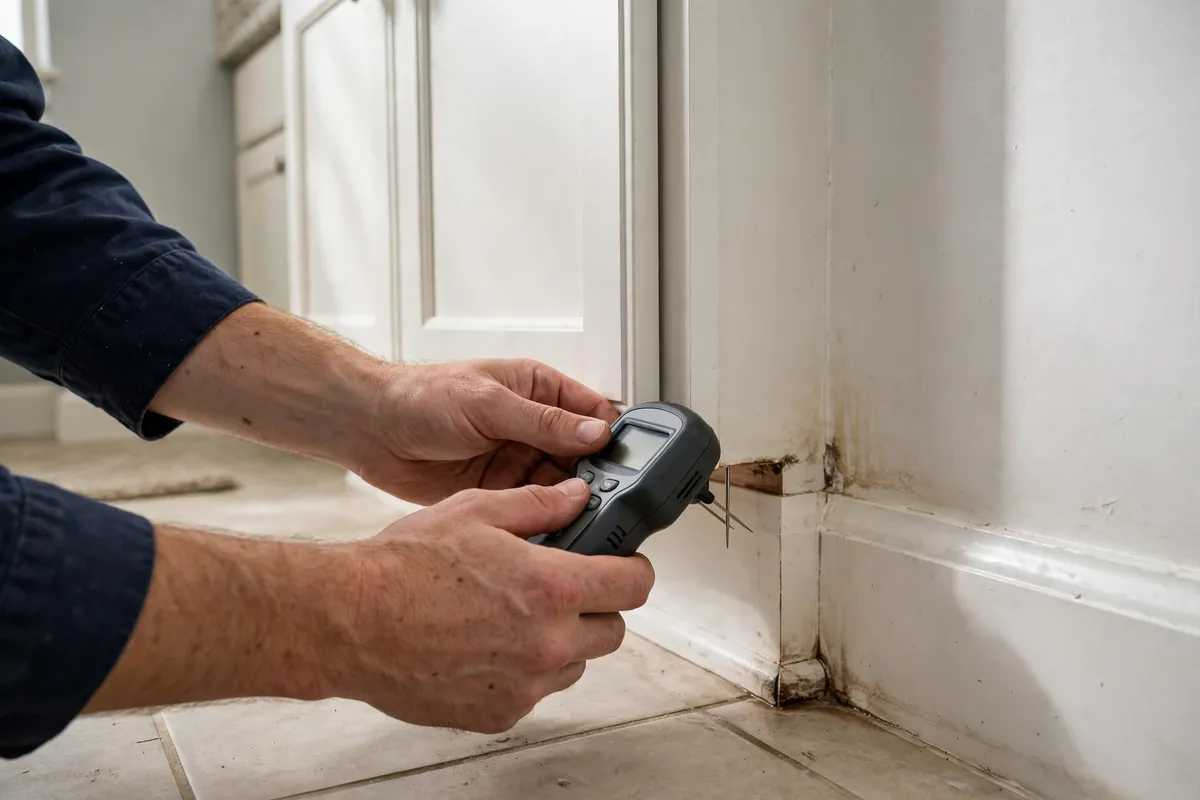
Map the moisture. A moisture meter checks the floor, baseboards and walls. A thermal camera can help flag areas for further inspection, and the meter confirms them.
Extract. Pumps and extractors pull the standing water off the floor.
Remove what can’t be saved. Depending on the category, that can be carpet pad, swollen cabinet bases and soaked lower drywall.
Wash, then disinfect. Hot water and detergent first, because disinfectant doesn’t work on a dirty surface, then an EPA registered disinfectant.
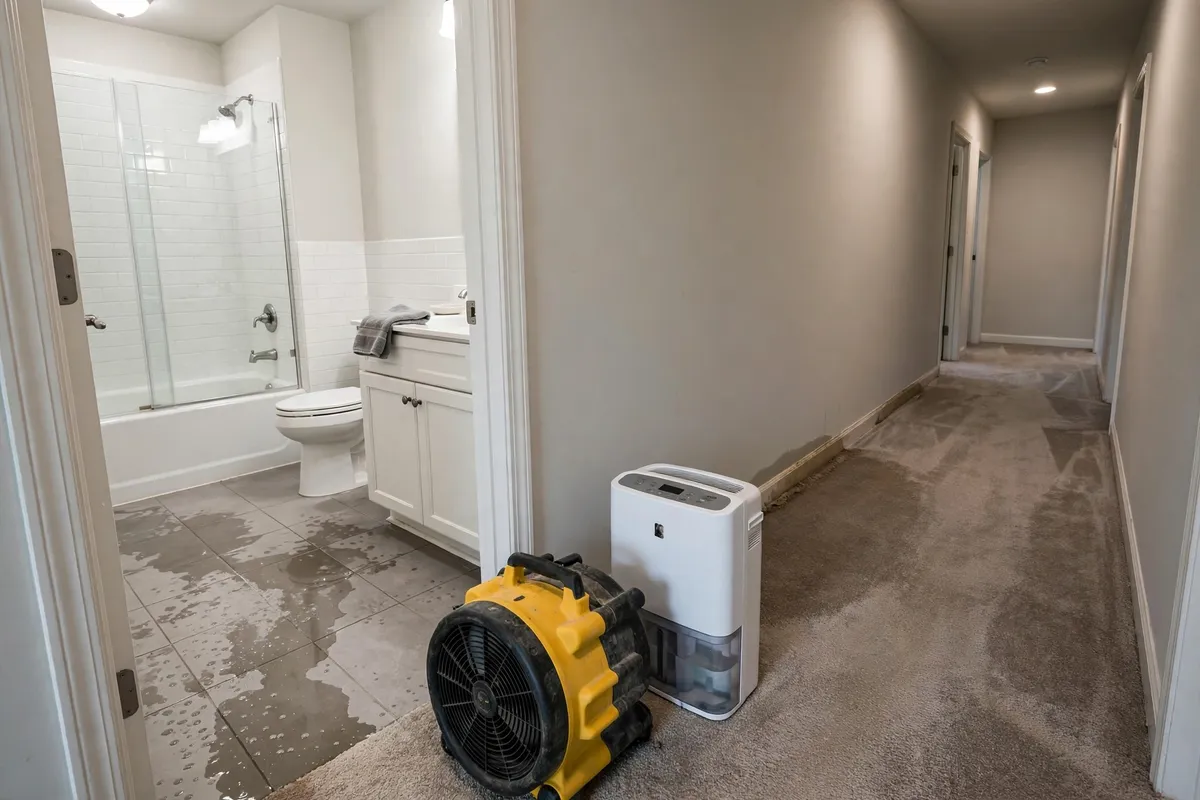
Dry. Air movers and dehumidifiers dry the floor and walls. See our structural drying page for the method.
Check and hand off. The crew reads the meters against a dry reference and can share the readings with you.
What about a sink, vanity or tub overflow?
The steps are the same. The water category depends on the source and what is in the water. Water from a supply line is clean when it starts. Water from a clogged drain has already touched soap, hair and skin, so crews assess it before they decide how to treat it. A moisture meter on the floor and the vanity base settles how far it went.
- Sink or vanity. Water over the rim or from a supply line runs down the cabinet face and under the toe kick. Particleboard bases soak it up, so the crew checks the base and the wall behind it.
- Tub or shower. An overflow can run under the tub apron and out onto the floor, so the crew checks the floor along the tub edge too.
- Upstairs bathroom. Water can run down through the floor into the ceiling below. Stay out from under a stained, bulging or dripping ceiling, shut off the water and call. The crew checks the ceiling and the walls below.
- If your home is on a slab, a downstairs bathroom overflow has nowhere to drop, so it spreads sideways into the hall or the next room.
For a clogged trap or a failed supply line, call a plumber for the repair. We handle the water.
Is the water from an overflowing toilet clean, gray or sewage?
It depends on where the water came from and what is in it, and bowl water should be treated as contaminated. Water that came only from the tank or a supply line starts out clean. Bowl water can carry germs, and water with waste in it, or water that came up from beyond the toilet’s trap, is sewage. A crew sets the category from the source and an inspection of the water.
Restoration crews sort water with the IICRC S500 standard. The standard is a classification system, and we don’t claim it as our certification. Guides from Wrightway and ARO Restorations draw similar lines.
| Where the water came from | What it usually means for the job |
|---|---|
| Tank or supply line leak | Starts as clean water. Often dried in place after a moisture check, unless it sat or touched soiled materials |
| Toilet bowl overflow | Treat as contaminated. Wash and disinfect, and check porous materials. If waste is in it, treat it as sewage |
| Suspected sewer backup | Treated as sewage. See our sewage backup cleanup page, not this one |
Water from a clean source can become contaminated depending on what it contacts, how long it sits, and the temperature. The EPA says to dry water damaged areas and items within 24 to 48 hours to prevent mold growth.
How can I tell if it is the main line and not just the toilet?
Look for these signs:
- Other drains gurgle or run slow.
- Water rises in the tub or shower while you plunge the toilet.
- More than one fixture backs up.
- A sewer smell comes from the floor drain or the tub.
If water or sewage is backing up into more than one fixture, stop using water and call a plumber to check the drain line. For contaminated water removal, see our sewage backup cleanup service.
Could this be a city sewer issue?
It can be. On June 4, 2025, a 24 inch sewer main collapsed near Liberty Grove Road and Chiesa Road in Rowlett, and sewer backups followed, CBS Texas reported. The city asked residents to avoid flushing toilets, then asked people in the outlined area to stop non essential water use after a second collapse on June 5. If your neighbors have the same problem, call Rowlett Public Works at (972) 412 6287 on weekdays, or (972) 412 6201 after hours for water and sewer emergencies.
Who fixes what: plumber or cleanup crew?
A plumber clears the clog and fixes the part. We remove the water and dry what it soaked. A plumbing overflow cleanup needs both trades, so stop the water first, then call both.
| Job | Plumber | Us |
|---|---|---|
| Clear a clogged toilet or drain line | Yes | No |
| Replace a flapper, fill valve, supply line or wax ring | Yes | No |
| Reset the toilet on its floor flange | Yes | No |
| Pull out the standing water | Rarely | Yes |
| Find hidden moisture with a meter | No | Yes |
| Wash and disinfect the floor | No | Yes |
| Dry the floor and walls, and record the readings | No | Yes |
We don’t unclog or repair toilets, remodel bathrooms or remove mold. We say so when you need another trade.
Where does the water go in a Rowlett home?
Across the bathroom floor first, then out the doorway. If your bathroom sits on a concrete slab, the water has nowhere to drop. It spreads flat, wicks into the baseboards and lower drywall, and can run under the flooring into a hall, a bedroom or a closet next door.
| Surface | What the water does | What usually happens |
|---|---|---|
| Tile and grout | Runs under the edges and sits in grout lines | Often dried in place, with a moisture check |
| Vinyl plank or sheet vinyl | Slips under the edges and sits on the slab | Often lifted to dry the floor under it |
| Baseboards and lower drywall | Wick moisture up from the floor | Checked with a meter, cut if needed |
| Vanity base and toe kick | Water runs under the toe kick into the cabinet base | Checked, and particleboard bases often come out |
| Carpet in the next room | The pad holds the water | Removed if the water was contaminated |
| Bedroom closet floor | Many bathrooms back onto a closet | Checked with the meter before anything is pulled |
A mop only gets what you can see, and toilet overflow cleanup that stops at the surface leaves the walls wet. For bathroom flood cleanup, a moisture meter reads inside the material, so we put it on the walls and floors on the other side of the doorway too.
Can I clean up a toilet overflow myself?
Only a small spill of clean tank or supply water on a hard floor. A standard toilet uses 1.6 gallons per flush, and older toilets can use as much as 6, the EPA says, so a flush that kept running can be a lot of water. If it was bowl water, ran for a while, reached a wall or another room, or came with waste, call a crew.
If you do handle a small spill:
- Wear rubber gloves, boots and eye protection.
- Wash the floor with hot water and detergent, the CDC says, and let it dry fully.
- Bag the rags and towels, and wash your hands with soap and water.
- Keep children and pets out until you are done.
Water under the toe kick or behind the baseboard stays wet after the top looks dry, and only a meter shows it.
Is a leak at the base of the toilet the same problem?
A slow leak at the base is easy to miss. A wax ring seals the toilet to the floor flange. When it fails, a little water seeps out with each flush and can sit under the flooring for weeks before you see it, Sensible Digs reports.
Signs of a failing seal, according to Edwards Plumbing:
- Water around the base after a flush
- A sewer gas smell near the toilet
- A toilet that rocks or wobbles
- Soft, stained or lifting flooring around the base
Caulk around the base can hide the leak and trap the water. A plumber reseats the toilet and replaces the ring. We dry the floor it soaked. Insurance treats the two differently, as the insurance section below explains.
What can be saved after the water spreads?
Hard, solid surfaces can usually be washed and dried in place. Porous materials that touched contaminated water usually can’t. The CDC says to throw away what you can’t clean or dry quickly, like carpet, mattresses and upholstered furniture, and to remove drywall and insulation that sewage or floodwater soaked.
| Usually removed | Usually washed and dried in place |
|---|---|
| Carpet pad in the next room | Concrete slab |
| Lower drywall and insulation that sat wet | Tile with sound grout |
| Particleboard vanity bases | Sound framing lumber |
| Swollen laminate | Solid surfaces, case by case |
We tell you what stays before we start. Take photos when it’s safe, and ask your adjuster how to document contaminated items before you throw them out.
How long does it take to dry, and will mold grow?
It depends on how far the water spread and what it soaked. We stop when meter readings in the wet areas match a dry reference, not before. Hardwood and soaked insulation usually take longer than tile.
Mold can start if wet materials stay damp, and the EPA says to dry water damaged areas within 24 to 48 hours to prevent it. Texas licenses mold assessment and remediation. We don’t remove mold, and if you see or smell it, we’ll point you to a licensed company.
Does homeowners insurance cover toilet overflow damage?
Often, if it was sudden and accidental. TDI says most homeowner and renters policies cover sudden and accidental water damage, and it names a toilet overflow as an example. Most home policies don’t cover water damage from gradual leaks or seepage, so a slow leak at the base usually falls outside.
- Sewer or drain backup. Standard policies typically exclude it unless you added a water backup endorsement, the Texas A&M Real Estate Research Center explains. Check your declarations page.
- The failed part. Ask your agent whether the water damage and the worn toilet part are treated separately.
- Document first. TDI says to take pictures or videos before repairs and to keep receipts. Temporary repairs are fine, but wait on permanent ones until your insurer has seen the damage.
- Renters. The owner’s policy won’t cover your belongings. Renters insurance may cover damaged belongings, depending on the cause and your policy.
TDI answers questions at (800) 252 3439. Your policy and your insurer decide what is covered.
How do I prevent the next overflow?
Know what your toilet can’t handle, and fix a running toilet early. Plumber guides from Angi and Roto-Rooter name the usual causes: too much toilet paper, wipes and other things that shouldn’t be flushed, a fill valve that won’t shut off, a stuck flapper and a float set too high.
- Flush only toilet paper and waste, even if a package says flushable.
- If the toilet runs on after a flush, have the flapper or fill valve fixed. The EPA says household leaks can waste 180 gallons a week, and toilets are often the cause.
- Find the valve behind the toilet now, and turn it off and on twice a year to make sure it moves.
- SERVPRO suggests checking the supply line and the wax ring every six months.
- If it overflows more than once, ask a plumber to check the main line.
Toilet & Fixture Overflow Cleanup in Rowlett
We take calls for Toilet & Fixture Overflow Cleanup in Rowlett ZIP codes 75088 and 75089, from Downtown Rowlett near Main Street and City Hall to the homes along Lake Ray Hubbard, Lakeview Parkway, Dalrock Road and Miller Road. Call to confirm your address, and to check coverage if you are in a nearby city. For other water damage in Rowlett, see our emergency water extraction page.
Toilet overflowed in your Rowlett home? Call (555) 247-0199.
What you can expect when you call
- Questions first. We ask where the water came from, which fixtures, and how long it ran, because that sets the water category.
- Moisture readings. They show where the water went, and the job ends when they read dry.
- A record you can use. The crew takes photos and moisture readings, and you can ask for copies for your adjuster.
- Plain advice. We tell you when you need a plumber and what we don’t do.
Toilet overflow cleanup questions Rowlett homeowners ask
What should I tell you when I call?
Tell us where the water came from, which fixtures were involved, how long it ran, and which rooms and floors got wet. Say whether anything with waste in it came up. Give us your address and ZIP code. Photos help, and we ask what your floors are made of.
What if the water reached the hallway or another room?
Call soon and say so. Water that left the bathroom can sit under flooring, behind baseboards and in the carpet pad next door. A moisture meter finds it. Keep people off the wet floor, take photos from a dry spot, and don’t move wet carpet yourself.
What if the overflow happened upstairs?
Water can run down through the floor into the ceiling below. Stay out from under a stained, bulging or dripping ceiling, shut off the water if you can reach the valve from a dry spot, and call a plumber and us. The crew checks the ceiling and walls below with a meter.
What if the toilet overflowed while I was away?
Call as soon as you see it, and tell us how long you think it ran. A longer run usually means the water went farther. The EPA says to dry water damaged areas and items within 24 to 48 hours to prevent mold growth.
Is it safe to stay in the house?
Keep everyone out of the wet room, and keep children and pets out until it is cleaned. Treat bowl water as contaminated, and wash your hands with soap and water after any contact. If you smell sewer gas, or water is backing up in other fixtures, call a plumber.
Should I move furniture and belongings out?
Only what you can lift from a dry spot without stepping into the water. Take photos first. For anything contaminated, ask your adjuster how to document it before you throw it out. TDI says to take pictures or video before repairs.
How much water does a running toilet waste?
The EPA says household leaks can waste 180 gallons a week, and toilets are often the cause. A standard toilet uses 1.6 gallons per flush, and older models can use as much as 6.
Call now for Toilet & Fixture Overflow Cleanup in Rowlett
Turn off the water, then call (555) 247-0199 for toilet overflow cleanup in Rowlett. Call to confirm service availability for your address in Rowlett.
Call (555) 247-0199Sources
(last updated November 2026)
- U.S. EPA WaterSense: toilet flush volumes and household leaks
- U.S. EPA: A Brief Guide to Mold, Moisture and Your Home
- Texas Department of Insurance: when water damage and mold are covered
- CDC: Guidelines for Cleaning Safely After a Disaster
- CBS Texas: Rowlett sewer main collapse, June 2025
- City of Rowlett: Public Works
- Texas A&M Real Estate Research Center: Come Rain or High Water (sewer and drain backup endorsements)
- Wrightway and ARO Restorations: toilet overflow water categories and cleanup
- Cleanfax: water damage categories
- SERVPRO: flooded bathroom guide
- Edwards Plumbing and Sensible Digs: toilet base leaks
- Angi, Roto-Rooter and Piping Craft: toilet overflow causes and the drain opener caution
- Texas Department of Licensing and Regulation: Mold FAQ