Moisture Detection & Mapping in Rowlett, TX
Think there is water inside your walls or under your floors, or want to know how far a loss spread? A thermal scan helps find areas worth checking, a moisture meter confirms them, and moisture mapping puts the readings on a map so the wet area is on paper. Call (555) 247-0199 to talk through what you are seeing.
Water that soaked into drywall, framing and flooring doesn’t show up in a stain until days later, and sometimes never. We scan the area, confirm what we find with a meter at accessible test points, mark the wet boundary and give you the readings. We cover ZIP codes 75088 and 75089 in Rowlett. Call to confirm service for your address.
Request Moisture Detection & Mapping in Rowlett: (555) 247-0199. If there is still standing water, start with our water extraction page.
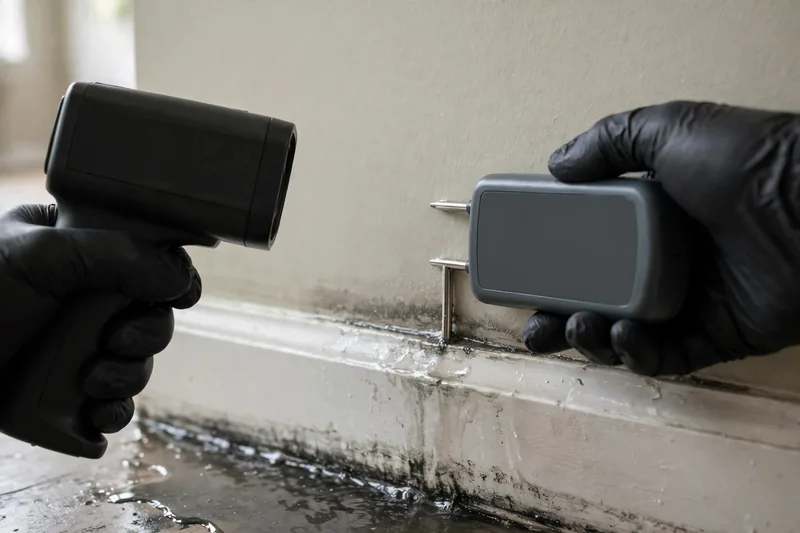
What is moisture mapping, and what do I get?
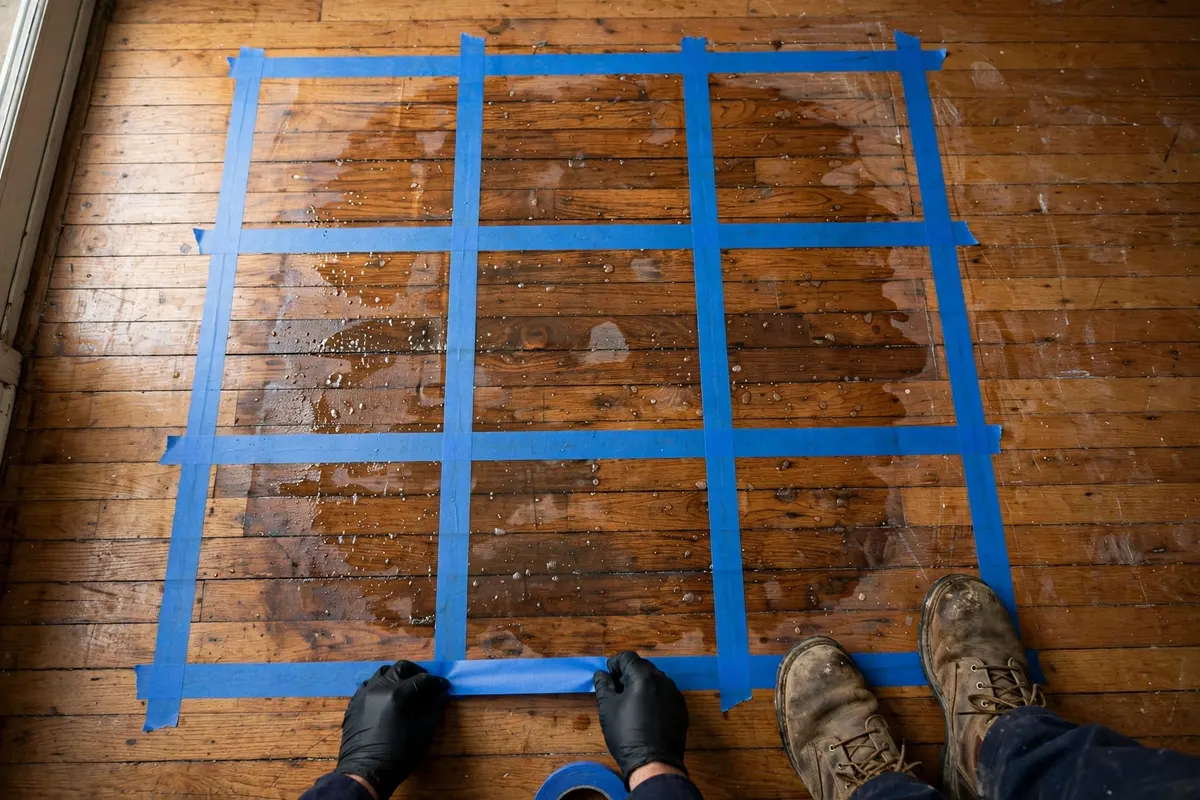
Moisture mapping is recording moisture readings across an area and drawing them on a map, so you can see how far the water spread. The map is a drawing or a photo of the affected surfaces with a grid on top. Each grid point has a reading. The wet area is shaded, and the wet boundary marks where the readings return to normal.
A stain doesn’t show the full extent of a loss. Water climbs through porous materials above the level it ever stood, which is called wicking, so a wall can read wet higher than the visible waterline. The map draws the extent from readings instead of the edge of a stain.
What is in the readings record?
The record is a log of every reading, plus the dry reference it was compared with. Each line has a date, a material, a location and a value. Thermal images are saved too, each paired with the meter reading that settled it. Photos of the area and of the meter display are part of the file. A thermal image stays a lead until a meter reading at the same spot confirms it.
| What you receive | What it shows |
|---|---|
| Moisture map | The grid, the readings, the wet area and the wet boundary |
| Readings log | Date, material, location and value for every reading |
| Dry reference | The same materials read in a dry part of the building |
| Thermal images | Leads, each paired with the meter reading that settled it |
| Photos | The area and the meter display |
After a loss, insurance adjusters often work from this kind of record. We provide the documents. We don’t handle claims or decide coverage.
What does a moisture detection visit look like step by step?
A visit finds the water, measures it, maps it and hands you the record. It runs in seven steps.
Listen and look
You tell us where the water came from, when it happened and what you have noticed. We walk the area and note stains, smells and changes in the floors and trim.
Take the air readings
A thermo-hygrometer gives the air temperature and humidity of the rooms. This is the air side of the record.
Scan for suspects
A thermal camera shows temperature patterns on surfaces. A cool patch is only a suspect until a meter confirms it. A pinless meter sweeps walls and floors quickly to find where moisture begins and ends.
Confirm with a meter
A pin meter puts a number on the layer we care about. The technician checks suspected areas with a meter where access allows and notes any findings that could not be confirmed.
Set the dry reference
We read the same materials in a dry, unaffected part of the building. Those readings are the baseline everything else is compared with.
Map it
We lay a grid over a drawing or photo of the area, record a reading at each point and draw the wet boundary where the readings return to the dry reference. We note where the water most likely entered the materials. That is a moisture finding. A pipe diagnosis belongs to a plumber.
Hand over the record
You get the map, the readings log and the photos. If a drying job follows, we mark test points so the same spots can be read again.
Which tool answers which question?
Three tools answer three different questions, so a visit carries all three. Each one on its own can mislead.
| Tool | The question it answers | What it can’t tell you |
|---|---|---|
| Moisture meter (pin and pinless) | How wet is this material, right here? | What is happening in the air, or in a spot we haven’t read |
| Thermal imaging camera | Where should we look first? | How wet anything is. It reads temperature, not water |
| Thermo-hygrometer | What are the air temperature and humidity doing? | What is inside a wall. It reads the air only |
If the map shows wet materials that need drying, see our structural drying and dehumidification page.
When does timing matter for a moisture check?
Earlier is better, because a map made before repairs shows what is behind the finish. Closed walls and finished floors can limit which layers we can assess. Three points in a job are worth planning around:
Before any drying starts. The map shows which rooms, walls and floors need drying, so the plan fits the loss.
Before walls are closed or repairs start. Framing and drywall should reach their drying goal before a contractor covers them.
For shops, offices and multi-unit buildings. A map by suite or by floor shows where the water crossed a wall and where it didn’t.
Moisture mapping services like this are most useful at those points.
How should I get ready for a moisture check?
Gather what you know, keep the area as it is and tell us what has already been done. A few small things make the visit faster and the map more accurate:
- Write down when the water appeared, where it came from and when the source was fixed.
- Take photos of the stains, floors and anything that has changed.
- Tell us who has already worked on it, such as a plumber or a drying crew, and what they did.
- Don’t paint, patch or close up a wall before the check. Paint can hide what the readings need to show.
- If drying equipment is running, leave it running and tell us how long it has been on.
- Make sure we can reach the affected rooms, the cabinets and the baseboards.
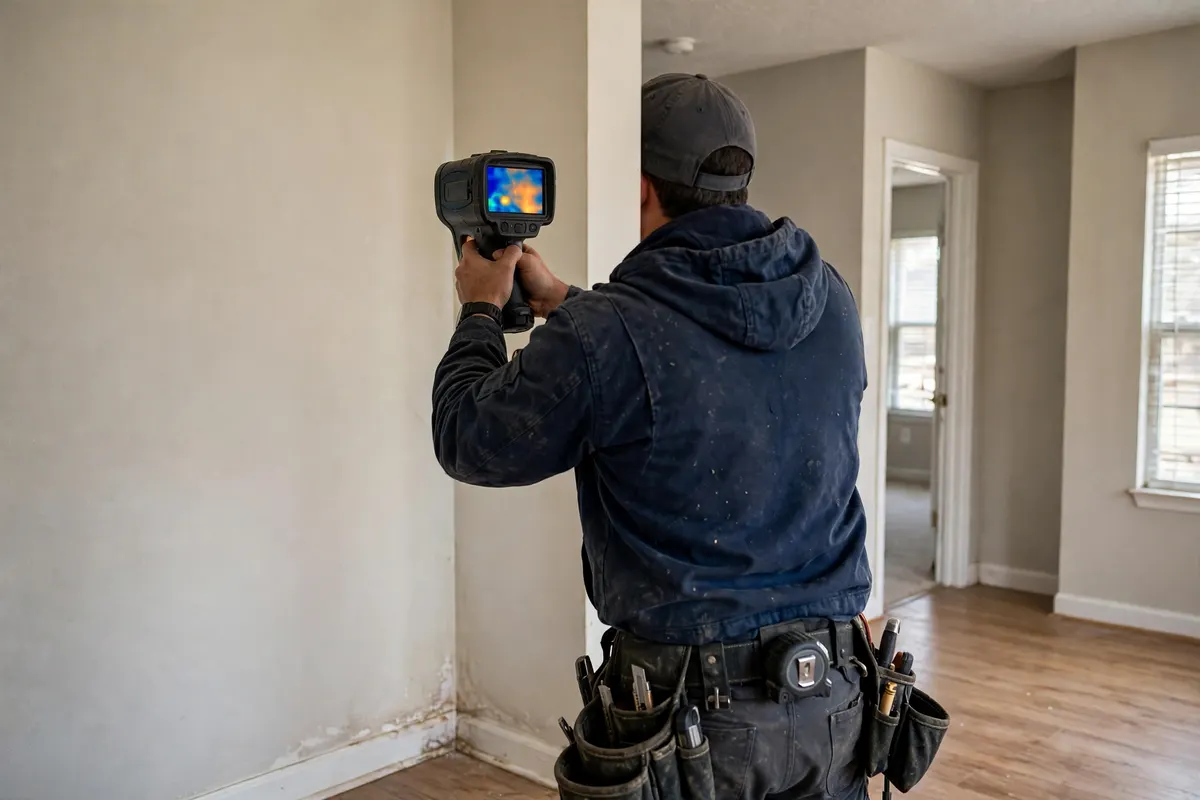
Can a thermal camera see water inside a wall?
No. A thermal camera reads the temperature of the surface in front of it and nothing behind it. It can’t see through walls, and it can’t tell you how wet a material is. What it can do is show a cool or warm patch that is worth checking, which saves time on a big area. A meter reading is what makes it a finding.
Why does wet material show cooler?
Water evaporating from a surface carries heat away, so wet material usually reads cooler. That is called evaporative cooling, and it is the basis of thermal scanning for moisture. The camera picks up the cooler patch, and the technician checks the spot with a meter.
What does the camera miss?
A cool patch can be a draft, a stud, missing insulation, a cold pipe or an air leak, and it can be nothing at all. The camera misses wet material that sits at room temperature, or water trapped where it can’t evaporate. Material that has been wet a long time can settle at the same temperature as the air around it and disappear from the scan. This is why every anomaly gets a meter reading at the same spot, and why a thermal image alone can’t clear an area as dry.
Condensation can fool the camera too. Warm air that meets a surface below its dew point leaves moisture on it, so a cold wall can be wet with no leak behind it. The thermo-hygrometer helps sort that out.
How do moisture meters work? Pin and pinless
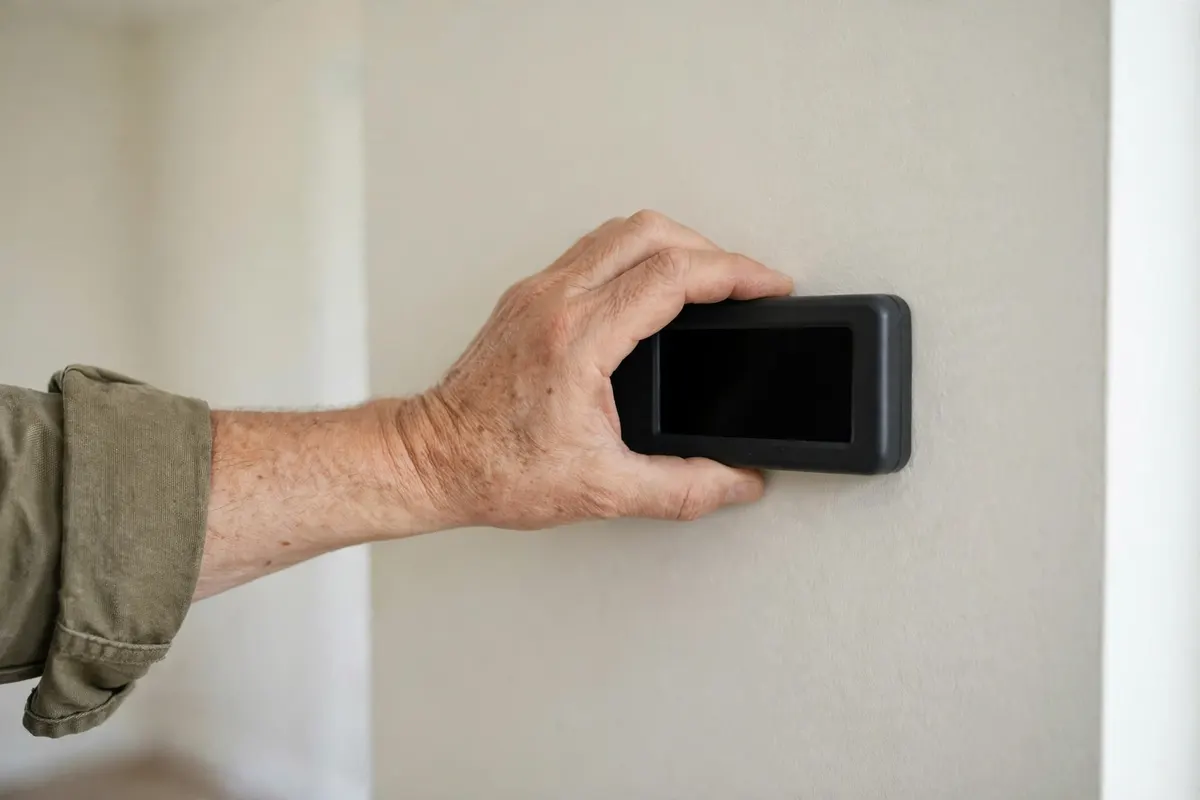
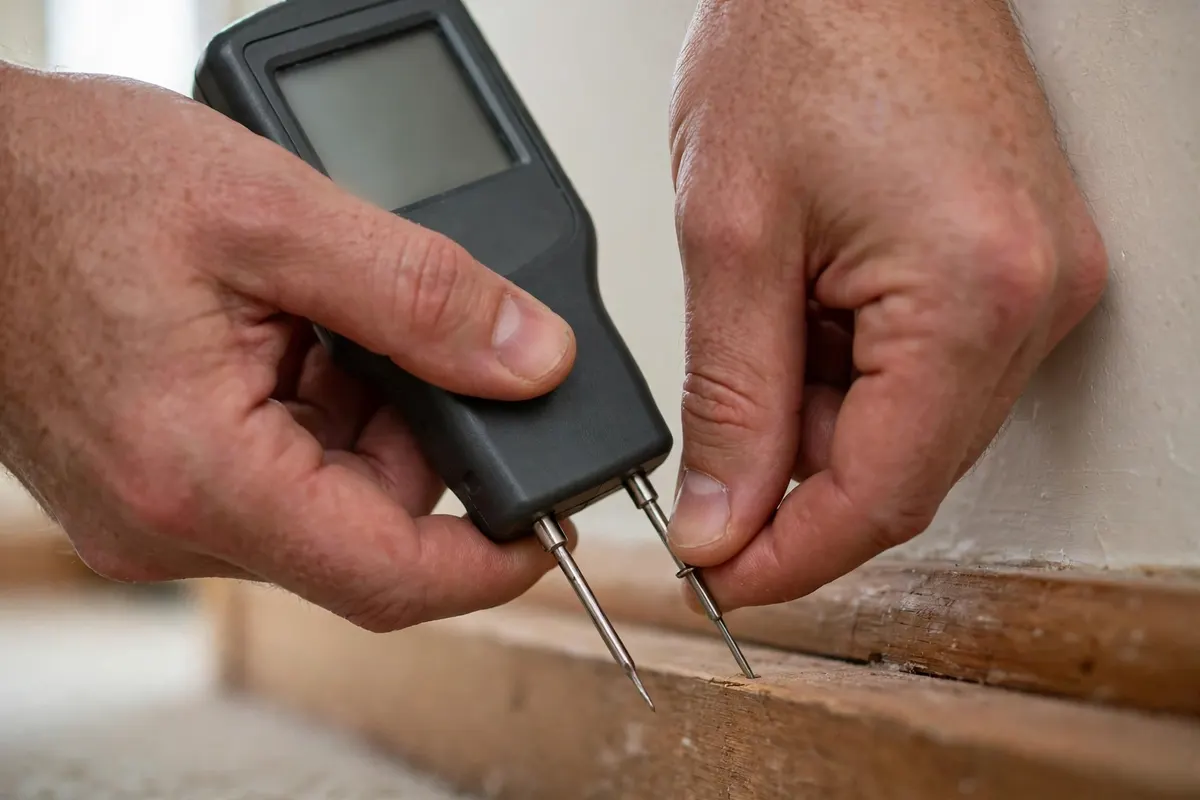
A pin meter reads electrical resistance between two pins pushed into a material, and a pinless meter reads a zone through the surface with an electromagnetic field. They answer different questions, so a good moisture inspection uses both. The pinless meter finds the edge of the wet area fast. The pin meter puts a number on the layer.
| Pin meter | Pinless meter | |
|---|---|---|
| How it reads | Resistance between two pins | An electromagnetic field through the surface |
| What it reads | The material at the depth of the pin tips | A zone below the surface. Depth varies by meter model, setting and material |
| Strength | A direct number at a point | Fast sweeps with no marks |
| Limit | Leaves two small holes | Thrown off by dense material and by metal behind the surface, such as lath, foil, corner bead and wiring |
Deep wall probes are long pins that reach through drywall to the studs and bottom plate, so the layer behind the finish gets a number. A borescope is a small camera on a flexible probe. It looks inside a wall cavity through an opening that already exists, or a small hole. It is a look, not a reading.
What does a reading mean on its own scale?
A reading means something only on the meter’s own scale and only against a dry reference. Pin meters give a true moisture content in wood. In drywall and other materials they report a wood moisture equivalent, which is what wood would read in balance with that material. Pinless meters give a relative reading, which is a comparison number that isn’t a percentage.
Every maker has its own scale, and the scales don’t convert. A number on one maker’s meter doesn’t carry over to another’s, and the same meter reads different materials differently. This is why we never state one safe percentage for a wall. We compare each reading with the dry reference from your own building, and the S500 water damage standard asks for that kind of baseline.
Where does water hide in a Rowlett home?
It hides in the spaces you can’t see: inside wall cavities, behind baseboards, under flooring, above ceilings and in the hollow under kitchen cabinets. Many North Texas homes sit on a concrete slab. If yours does, water that spills on the ground floor spreads flat across it, wicks into the walls and runs under hard flooring, and surfaces in rooms away from where it started. Porous materials wick water above the visible waterline, and the face of a wall dries before the layers behind it, so the map goes above the stain, and a dry surface says little about the layers behind it.
| Where | Why it hides | How we check it |
|---|---|---|
| Wall cavity and stud bays | The painted face dries first, and wet insulation holds water against the framing | Pinless sweep, pin and deep probe readings bay by bay, a borescope where an opening exists |
| Behind baseboards | The base of the wall traps moisture where nobody looks | Readings at the base, a look behind the trim |
| Under flooring | Water spreads flat under hard flooring and surfaces rooms away | Sweeps and readings across the floor, checked against the dry reference |
| Subfloor over a slab | There is no space beneath to dry into | Readings on the subfloor and at the wall base |
| Ceilings and insulation | The stain marks where water arrived, which may differ from where it entered | Thermal scan, then readings above and around the stain |
| Cabinet toe kick void | The hollow under the cabinets holds water longer than any other spot | A look and a reading in the void |
What is a moisture monitoring visit, and how do you know it is dry?
A moisture monitoring visit is a return visit where we re-read the same marked spots and compare them with the last visit. “Is it dry” is answered by a trend in the numbers. We read the same test points each time, so the readings compare across days at the same place. Daily moisture monitoring is what this looks like during a drying job.
What is a test point?
A test point is a marked spot we re-read at every visit. Marking it means the numbers across days compare the same place. Readings that fall toward the target show progress. A reading that stops falling means water is still hiding or the setup needs to change.
What are the dry reference and the drying goal?
The dry reference is readings from comparable unaffected materials, where available. The drying goal is the target we set for each affected material from that reference. A monitoring visit checks whether each material has reached its goal. The readings decide when the job is done, and a fixed number of days can’t.
Monitoring here means a visit and a record. We don’t offer always on remote monitoring, and we don’t claim it. If you need the drying itself, our structural drying and dehumidification page covers it, including how the daily readings are part of that job.
What happens after the map?
The map points to one of four next steps, and we tell you which one. The result decides what comes next, and it isn’t always more work from us.
Readings at the tested points are within the expected range. The report identifies the materials checked and any areas the technician could not assess.
Materials are wet and can be dried in place. The map shows where drying should start. Our structural drying and dehumidification page explains how that works.
Some materials can’t be saved. Soaked insulation or badly wet material may need to come out. A contractor handles the removal and rebuild, and the map is what that decision is made from.
Water is still arriving. The source isn’t fixed. A plumber or roofer needs to stop it first, then we map again.
We also read the air. The EPA says indoor humidity should stay below 60%, and ideally between 30% and 50%. If the air is humid while the materials read dry, that is a different problem from a wet wall, and the readings show which one you have.
What is the difference between this and leak detection or a home inspection?
This service measures water in the materials. It doesn’t find holes in pipes, and it isn’t a home inspection. Three different jobs get confused, so here is the split:
| Job | What it looks for | Who does it |
|---|---|---|
| Moisture detection and mapping (this page) | Water that has already gotten into walls, floors and ceilings, and how far it spread | Us |
| Pipe leak location | A leak inside a pipe, found with acoustic listening equipment and pressure testing | A plumber or leak detection specialist |
| Home inspection | A whole home inspection for a buyer or seller, done to the TREC Standards of Practice | A TREC licensed home inspector |
In Texas, a real estate inspection for a buyer or seller is done by a license holder of the Texas Real Estate Commission. A moisture check after a water event is none of that, and we never call it one. Finding the source of a leak in a pipe belongs to a plumber. Measuring what the water did to the building afterward belongs to us. Many people need both, one after the other.
A map and a readings log are where we stop. Drying is covered on our structural drying and dehumidification page. Mold assessment and removal belongs to a company licensed by Texas. Rebuilding walls, ceilings and floors belongs to a contractor, and coverage decisions belong to your insurer.
Moisture detection in Rowlett
We take calls for Moisture Detection & Mapping in Rowlett ZIP codes 75088 and 75089, from Downtown Rowlett near Main Street and City Hall to the homes and businesses along Lakeview Parkway, Dalrock Road and Miller Road, and the properties near Lake Ray Hubbard. Call to confirm your address, and to check coverage if you are in a nearby city.
If your home sits on a concrete slab, water from one room can travel through the floor and the wall bases to rooms that never got wet at the surface. That is why a map of the whole ground floor tells you more than checking one spot. If the water is coming from the city main or the street, call Rowlett Public Works at (972) 412 6287 on weekdays, or (972) 412 6201 after hours for water and sewer emergencies. If the leak came from under the slab, our slab leak water damage drying page covers what happens next.
Want to know where the water went? Call (555) 247-0199.
What can you expect when you call?
- Questions first. We ask what you have noticed, where the water came from, when it happened and whether anyone has dried the area.
- The area. How many rooms, which floors and what the floors are made of changes the plan.
- A visit with a record. You get the map and the readings log.
- Plain advice. We tell you when you need another trade, and what we don’t do.
Questions people ask about moisture mapping
Does a moisture map mean my insurance claim is approved?
No. The map and readings log document what is wet and how far it spread. Your policy and your insurer decide what is covered and what is paid. We provide the documents and don’t handle claims. For coverage questions, the Texas Department of Insurance is a good place to start.
How long does a moisture check take?
It depends on how big the area is and how many rooms and floors we need to read. A single wall takes less time than a whole ground floor. We tell you what to expect when you call, and we don’t promise a time before we know the size of the job.
Do I need a moisture check if the water was already cleaned up?
If nobody took readings, it is worth asking. Cleanup removes what you can see. A check shows whether materials behind the surface are still wet, and it gives you numbers instead of a guess.
Will you cut holes in my walls?
The visit starts with non-invasive checks. If a probe or small access hole would help, the technician explains it and asks before proceeding. A pinless meter leaves no marks, and a pin meter leaves two very small holes. If material has to come out, we tell you what the readings show first, and a contractor does the cutting.
Do you check the whole house or just one wall?
It depends on what the readings show. We start where you saw the problem and follow the moisture until the readings return to the dry reference. In a slab home, water can travel across the ground floor, so the map often covers more than one room.
Call now for Moisture Detection & Mapping in Rowlett
Call (555) 247-0199 for moisture detection and moisture mapping in Rowlett. Call to confirm service availability for your address.
Call (555) 247-0199Sources
(last updated November 2026)
- U.S. EPA: Water damage table from Mold Remediation in Schools and Commercial Buildings
- Remediation Insider: meter guide compiled from manufacturer manuals (pin and pinless readings, scales)
- Tramex: moisture detection and moisture mapping practices, and the moisture map as a grid record
- FLIR: thermal imaging and moisture meter pages (what a camera reads and how a meter confirms it)
- ANSI/IICRC S500: water damage restoration standard, named for the dry reference
- American Leak Detection: residential pages on acoustic and pressure leak location
- Texas Real Estate Commission: consumer guidance on Texas property inspections
- Texas Department of Insurance: tdi.texas.gov
- City of Rowlett: Public Works