Carpet & Pad Water Extraction in Rowlett, TX
Carpet soaked after a leak? Keep people and pets out of the wet area, stay safe, and call (555) 247-0199.
Carpet water extraction in Rowlett means we pull the water out of the carpet and the pad, check what can be saved, and dry the floor until the moisture readings match a dry area. Call to confirm service for your address in ZIP codes 75088 and 75089. Your plumber fixes the leak. We deal with the water.
Call (555) 247-0199 to request Carpet & Pad Water Extraction in Rowlett.
What should I do first when my carpet is soaked?
Keep people and pets out of the wet area, stop the water if you can do it safely, and take photos from a safe spot. Standing water near outlets is a shock risk, and FEMA says standing water may be electrically charged.
- Stop the source if it is your plumbing. If a plumbing leak is still running and you can safely reach the shutoff valve, turn off the water. If the water came from outside or up from a drain, a valve won’t stop it.
- Do not cross standing water to reach the breaker. If reaching the panel means walking through water, stay out and call an electrician. The CDC gives the same warning about electrical hazards after a flood.
- Take photos and video of the carpet, the waterline and the source from a dry spot. The Texas Department of Insurance (TDI) says to take pictures before repairs.
- Stay off the wet carpet. Wet carpet backing is much weaker than dry backing, Cleanfax says, and walking on it can damage it.
- Call us for the water, and a plumber for the source.
Can I use a wet vacuum on it?
Only on a small, clean spill, and only when the electrical conditions are safe. A wet vacuum lifts water from the carpet surface, but it can’t pull water out of the pad underneath. If the spill is bigger, the pad is soaked, or the water may be contaminated, call a crew.
Can wet carpet be saved?
Sometimes. Three things decide it: the water category, how long the carpet has been wet, and the condition of the pad and the backing. Clean water that is extracted and dried quickly often saves the carpet. Sewage and outside floodwater do not, and in those cases the carpet and the pad are removed and disposed of.
What does the water category decide?
Under the IICRC S500 standard, restoration crews sort water into three categories. The standard only classifies water. We don’t claim an IICRC certification.
| Water | Carpet | Pad |
|---|---|---|
| Category 1, clean source (a supply line or a tank) | Often saved if it is dried quickly | Assessed on its own. Often saved if it is intact and dried |
| Category 2, gray water (a washing machine or dishwasher discharge) | Often saved after the technician inspects it | Usually removed and disposed of |
| Category 3, sewage or outside floodwater | Removed and disposed of | Removed and disposed of |
Water from a clean source can become contaminated depending on what it contacts, how long it sits, and the temperature. For clean water damage, EPA guidance recommends drying carpet and backing within 24 to 48 hours where possible.
Who decides about the carpet and the pad?
The carpet and pad are assessed separately. If the pad needs to come out, the technician checks whether the carpet can still be dried and saved. The decision depends on the water source, contamination, and the condition of the carpet backing and pad.
A pad that squeezes out water is a bad sign. So is a backing that peels away from the carpet. When the backing layers pull apart, that is called delamination, and a delaminated carpet usually can’t be saved.
Why is the pad usually the weak link?
Because the pad holds the water. The carpet face dries from the top, but the pad underneath is thick and dense, so it can stay wet long after the carpet feels dry. If your carpet sits over a concrete slab, moisture can remain trapped in the padding even after the surface feels dry. A pad with a film on top can trap water even more.
Gray water leaves soap and soil in any pad, and a pad is easier to replace than to clean. A carpet installer lays the new pad. We extract the water, remove a pad that can’t be saved, and dry the floor under it.
Does the carpet fiber matter?
A little. Restoration trade guides report that wool can shrink and bleed dye when it stays wet, and that jute backing can brown and smell musty. The pad and the backing matter more than the fiber.
What happens if wet carpet is left?
- Delamination. The backing layers separate.
- Shrinkage. The carpet pulls away from the walls.
- Dye bleeding and browning. Color runs, and jute or paper backing stains the pile.
- A musty smell. It can be a sign of lingering moisture. The carpet, pad, and floor should be checked to find the source.
- Mold. It can start if wet materials stay damp, which is why drying fast matters. Mold removal is not a service we offer.
What does Carpet & Pad Water Extraction include?
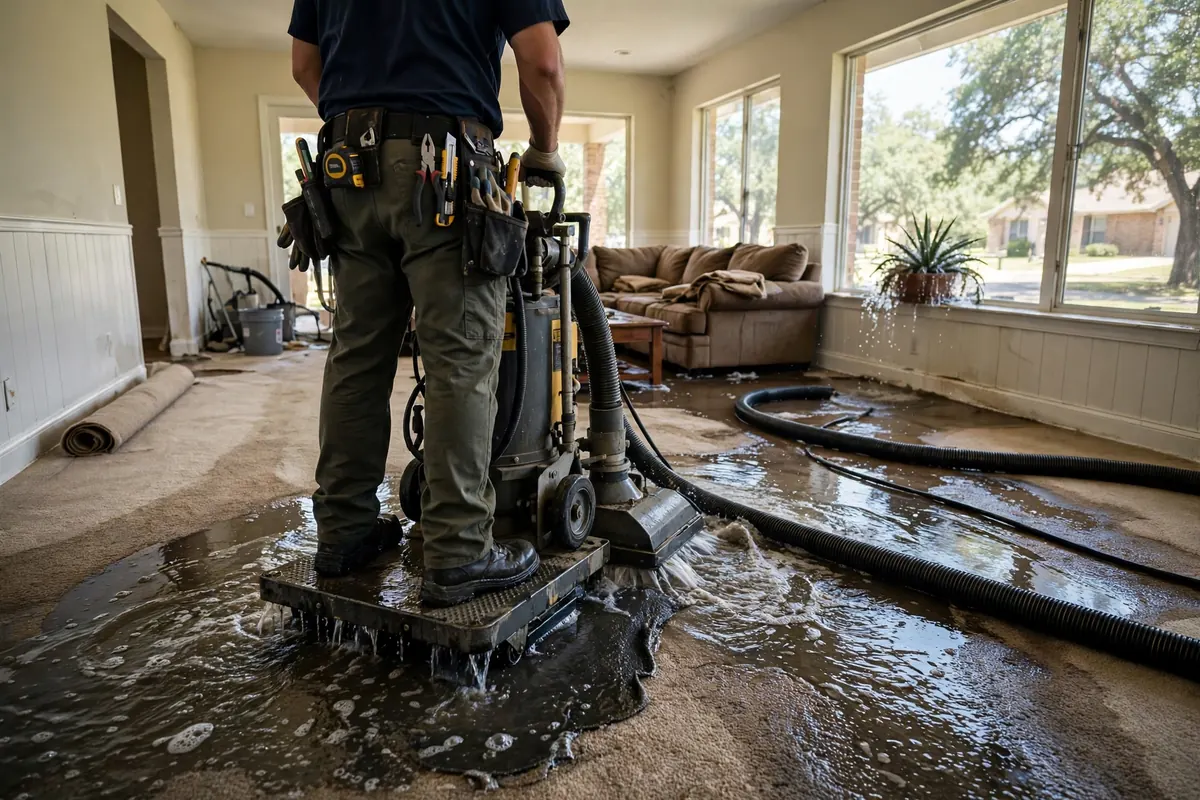
Carpet & Pad Water Extraction follows four steps: assess the water source, check the carpet and pad, extract the water or remove materials that can’t be saved, then dry and verify with readings. Carpet water extraction that stops at the surface leaves the pad wet.
Assess the source and the safety
The technician confirms the source is stopped and checks for electrical hazards.
Check the carpet and the pad
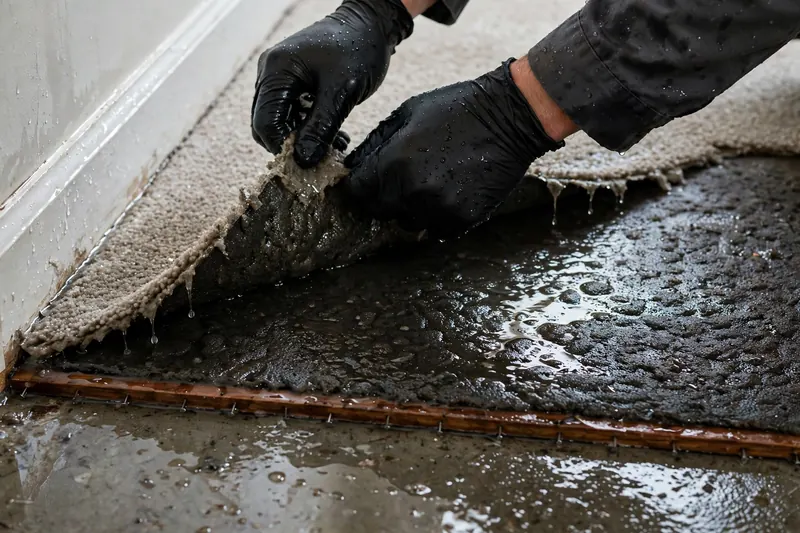
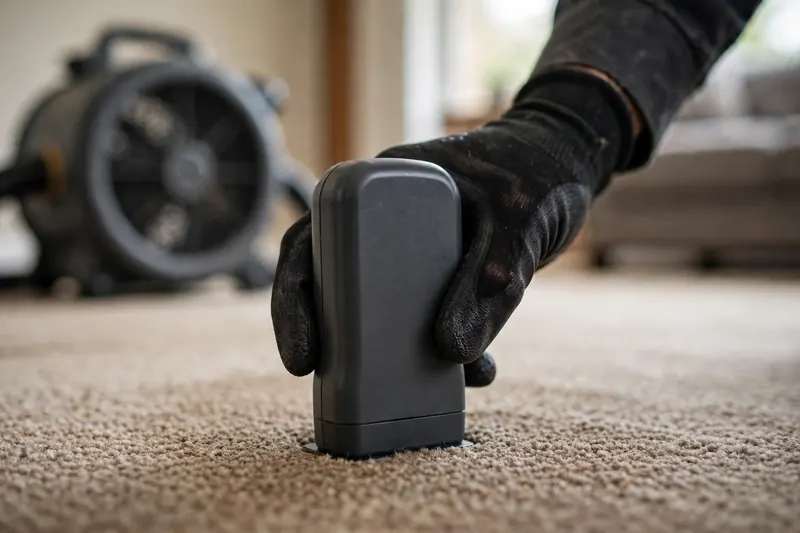
A moisture meter checks the affected materials and compares them with an unaffected area of the same material where possible. A thermal camera can help flag areas for further inspection. The technician lifts a corner or the tack strip edge where they need to see the pad.
Extract the water
A portable unit powers a weighted tool and a subsurface tool that pull water up through the carpet and the pad, worked in a grid. The weighted tool presses the carpet and compresses the pad so the water comes up. A regular wand only reaches the surface. Trade press, such as Restoration & Remediation Magazine, describes the same technique for portable units.
Remove what can’t be saved
If the pad can’t be saved, the carpet is detached and laid back, and the pad is cut out and disposed of.
Dry and verify
Air movers and dehumidifiers dry the carpet, the floor under it and the baseboards. Readings are taken on a schedule until the carpet, pad and the concrete slab beneath the pad match a dry reference.
You get photos and a moisture readings log for your claim, if the provider’s setup includes it.
How is carpet dried after water extraction: floating or in place?
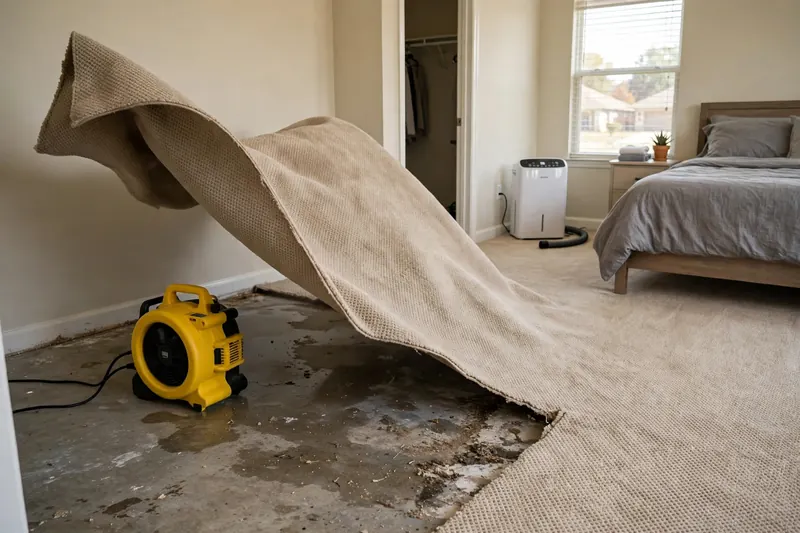
Either way, the readings decide when it ends. Drying means moving air across the carpet and the floor and pulling moisture out of the air, until the materials read like the dry parts of the house.
| Method | What it is | When it fits |
|---|---|---|
| Top down, in place | The carpet stays down and air is pushed through it | Clean water, an intact backing, a pad that can stay |
| Floating | The carpet is detached at the edges, lifted and propped on a cushion of air | Water under the carpet, or a pad that has to come out |
| Full removal | The carpet and the pad come out | Category 3, or a delaminated carpet |
Wet carpet drying that skips the floor under it leaves a damp floor under a dry looking carpet.
Glue down carpet and carpet tile
Some carpet is glued straight to the slab, or laid as tile, with no pad. Water sits on the slab, and the glue can soften and let go. That is mostly a shop and office job, so see our commercial water extraction page.
What if the water was sewage or floodwater?
Then the carpet and the pad are removed and disposed of. Sewage contaminated carpet and padding are removed and discarded. Category 3 water is sewage or ground level floodwater, and a trade source says Category 3 carpet damage is impossible to reverse.
The CDC says floodwater can carry sewage, chemicals and debris, and it says to throw away carpet, padding and other items you can’t disinfect. Keep children and pets out of the room, and wear rubber boots, gloves and goggles if you must go in.
For the whole cleanup after sewage, see our sewage backup cleanup page. For storm and flood water, see our flood water removal page. Wind driven rain or water entering from above is judged on inspection and contamination.
Who does what: carpet cleaner, installer, plumber or us?
We extract the water and dry the carpet, the pad and the floor under it. A plumber fixes the leak. A carpet cleaner cleans the carpet once it is dry, and an installer restretches or replaces it when needed. We don’t clean carpet, repair or install it, or remove mold.
Does insurance cover wet carpet?
Often, if the damage was sudden and accidental. Texas home and renters policies often cover sudden, accidental water damage, such as a burst pipe or broken washer hose. Outside flooding generally requires separate flood coverage. Check your policy and contact your insurer. Take photos when it’s safe and ask your adjuster how to document damaged materials before disposal. The Texas Department of Insurance answers questions at (800) 252 3439.
What did 2026 mean for wet carpet in North Texas?
Carpet gets wet from a few sources, and 2026 showed two of them. NBC 5 DFW reported that pipe bursts and water heater failures surged across North Texas after the January 2026 freeze. On June 19, 2026, the National Weather Service in Fort Worth issued a Flash Flood Warning for Collin, Dallas and Denton counties, and the text named Rowlett.
We found no count of wet carpet in Rowlett itself, so treat these as regional signals. The source matters for the carpet: a burst pipe is usually clean water, and outside floodwater is Category 3, where the carpet and the pad are removed.
Carpet & Pad Water Extraction in Rowlett
We take calls for Carpet & Pad Water Extraction in Rowlett ZIP codes 75088 and 75089, including neighborhoods along Lake Ray Hubbard, and call first to confirm coverage for your address. We also reach nearby Garland, Sachse, Wylie and Rockwall once coverage is confirmed. For other water damage in Rowlett, see our emergency water extraction page.
Wet carpet in your Rowlett home? Call (555) 247-0199.

What you can expect when you call
- The pad gets checked. The technician lifts a corner and looks, because the pad decides what stays.
- Moisture readings. They show where the water went, and the job ends when they read dry.
- A record you keep. Photos and a moisture readings log, for you and your adjuster.
- Straight advice. We tell you when you need a plumber, an installer or a cleaner, and what we don’t do.
Carpet and pad questions Rowlett homeowners ask
Can wet carpet be saved?
Sometimes. The water category, how long it has been wet, and the condition of the pad and backing decide. Clean water dried quickly often saves the carpet. Sewage or outside floodwater does not.
Why is the pad usually replaced?
The pad holds water the carpet doesn’t show, and it is slow to dry. Gray water leaves soap and soil in it. An installer lays the new one.
How do you extract water from carpet?
A weighted or subsurface tool pulls water up through the carpet and the pad, worked in a grid. A regular wand only reaches the surface.
Can carpet dry without being lifted?
Sometimes. If the water is clean, the backing is intact and the pad can stay, air can be pushed through the carpet in place. If water is under the carpet, it is lifted or floated. Moisture readings decide.
How long does wet carpet take to dry?
It depends on the water, how long it sat, the pad and the humidity in the room. We stop when readings match a dry reference.
What if the water was sewage or floodwater?
Then the carpet and pad are removed and disposed of. See our sewage backup cleanup page.
Who restretches or replaces the carpet?
A carpet installer. We extract and dry, and remove a pad that can’t be saved.
What should I tell you when I call?
Tell us your address and ZIP code, where the water came from, how long the carpet has been wet, and how much of the floor is wet. Say if the water may be sewage or from outside. Have your photos ready.
Call now for Carpet & Pad Water Extraction in Rowlett
Get safe, then call (555) 247-0199. Call to confirm service availability for your address in Rowlett.
Call (555) 247-0199Sources
(last updated November 2026)
- Texas Department of Insurance: water damage and mold coverage, and the disaster claims FAQ
- U.S. EPA: A Brief Guide to Mold, Moisture and Your Home, and its moisture control guidance for carpet and backing
- CDC: Guidelines for Cleaning Safely After a Disaster, and electrical safety after a flood
- FEMA: flood safety and electrical hazards
- National Weather Service Fort Worth: the June 19, 2026 Flash Flood Warning
- NBC 5 DFW: Pipe bursts and water heater failures surge as freeze eases in North Texas (January 2026)
- Cleanfax: Water damage categories, and Saving flooded carpet
- CleanLink: Restoration and remediation tips for water damaged carpets
- Restoration & Remediation Magazine: How to use portable water extractors in flood remediation
- IICRC: S500 water damage restoration standard (classification system)