Slab Leak Water Damage Drying in Rowlett, TX
Did the plumber fix the slab leak, but the floors still feel damp, smell musty, or the wall bases look stained? Slab leak water damage drying removes the water the pipe left in your slab, wall bases and flooring, and shows it with readings.
Water from a leak under the slab doesn’t leave with the pipe. It sits in the concrete, the lower walls, the baseboards and under your floor. We start once your plumber confirms the leak has been stopped or isolated, map where the water went, dry it and give you a dated record. We cover ZIP codes 75088 and 75089 in Rowlett. Call to confirm service for your address.
Call (555) 247-0199 for Slab Leak Water Damage Drying in Rowlett. If water is still standing on the floor, start with our water extraction page. If the pipe is still leaking, call a plumber first.
What is slab leak water damage drying, and what do I get?
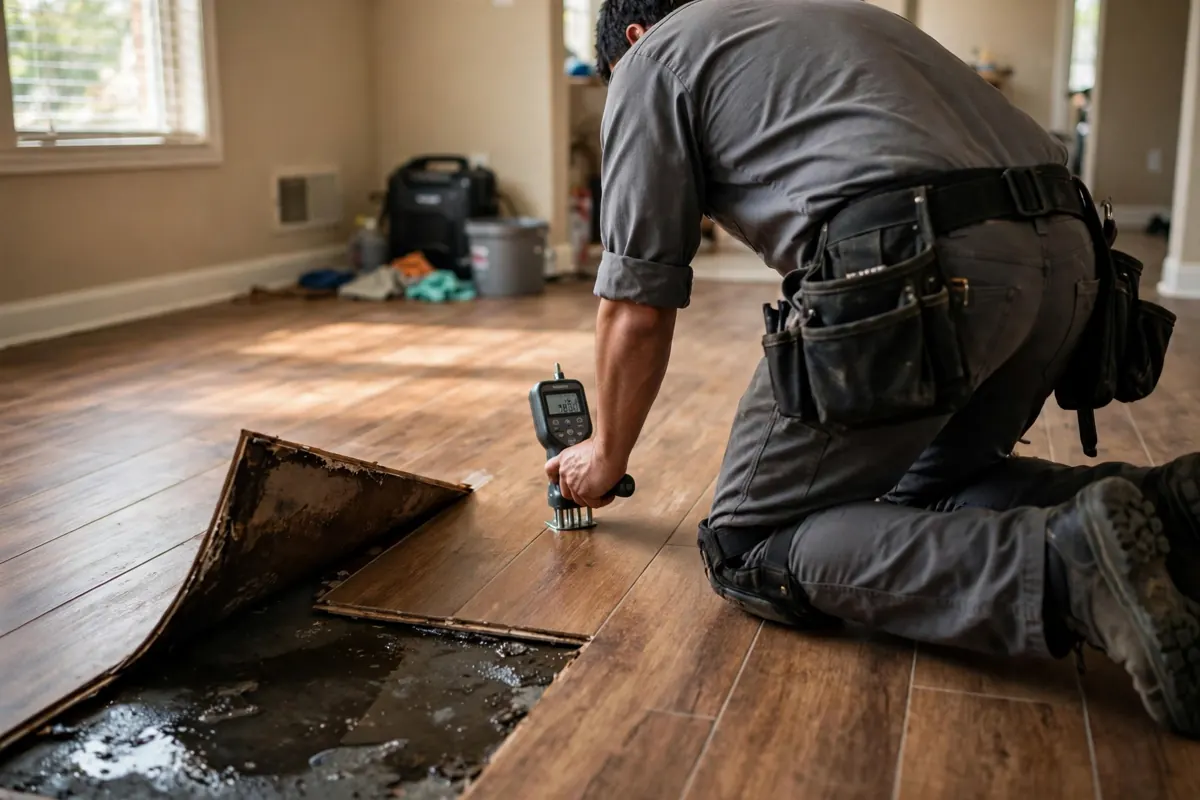
Slab leak water damage drying is removing the water a leaking supply line left in your slab, wall bases and floors, then reading the materials until each one reaches its drying goal, set from a dry reference. It applies to slab-on-grade homes, where the water lines run in or under the concrete. The plumber stops and repairs the leak. Drying is the second job, and the repair doesn’t include it.
We begin with a moisture map of the floors and wall bases. Our moisture detection and mapping page explains that visit. From there the job moves to drying, with a record at each step.
What is in the record you receive?
You receive the map, a dated drying log, the dry reference and photos. Each line of the log has a date, a material, a location and a value, taken at the same marked spots every visit.
| What you receive | What it shows |
|---|---|
| Moisture map | The grid, the readings, the wet area and the wet boundary |
| Drying log | Dated readings at the same test points, day by day |
| Dry reference | The same materials read in a dry, unaffected part of the home |
| Photos | The area, the opened spots and the meter display |
| Final drying readings | The readings for the areas tested, for whoever installs new flooring |
After a loss, adjusters often work from the plumber’s report plus this kind of record. We provide the documents. We don’t handle claims or decide coverage.
How does drying after a slab leak work step by step?
Drying runs in seven steps, and it ends when each material reaches its drying goal.
Confirm the repair
The plumber confirms the line was tested, the leak is fixed or isolated, and the water is back on where it should be. Drying against a live leak is wasted effort, so everything starts here. If your repair is still pending, our work starts after it. We don’t sell a visit before the plumber is done.
Walk and map
We take readings across the floors and the wall bases, read a dry part of the home for the reference, and draw the wet boundary on a plan. A thermal camera points at suspects. A meter confirms them.
Remove water and open access
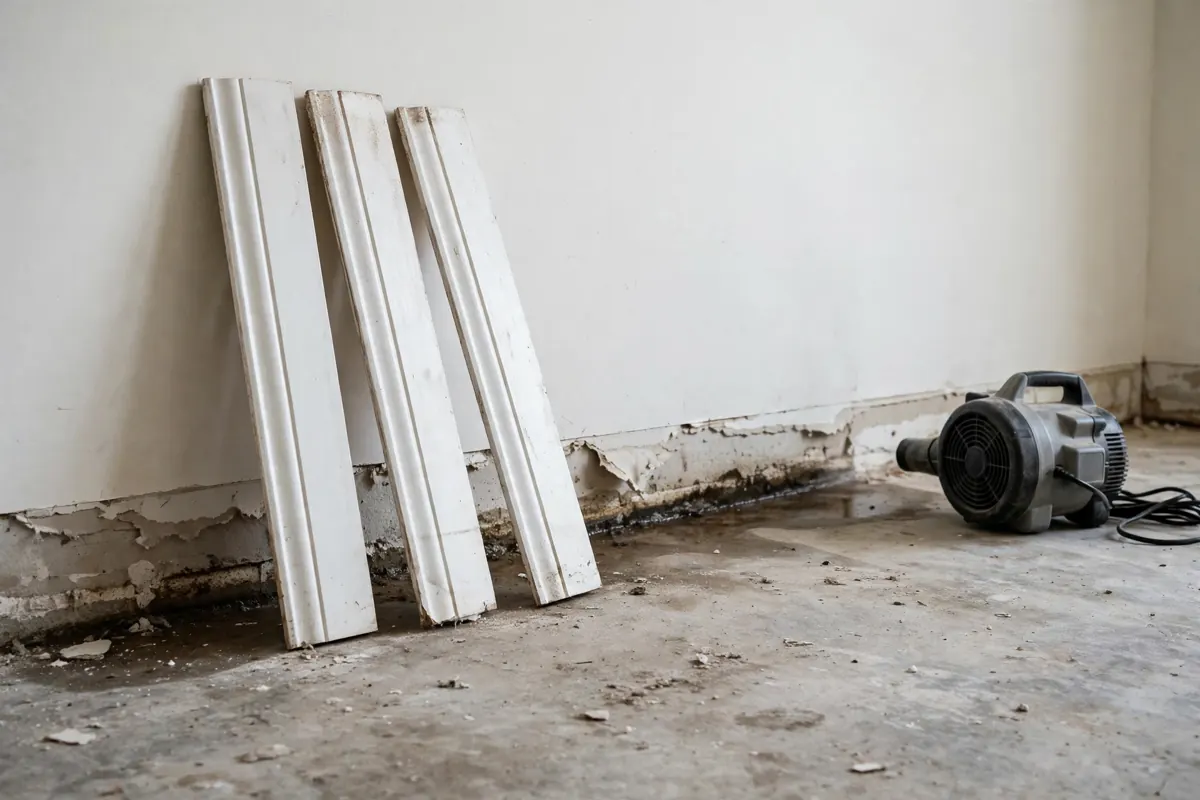
Standing water comes out first. Baseboards come off, cabinet toe-kick panels open, and flooring lifts only where the readings call for it. Every piece is photographed and logged.
Set the equipment
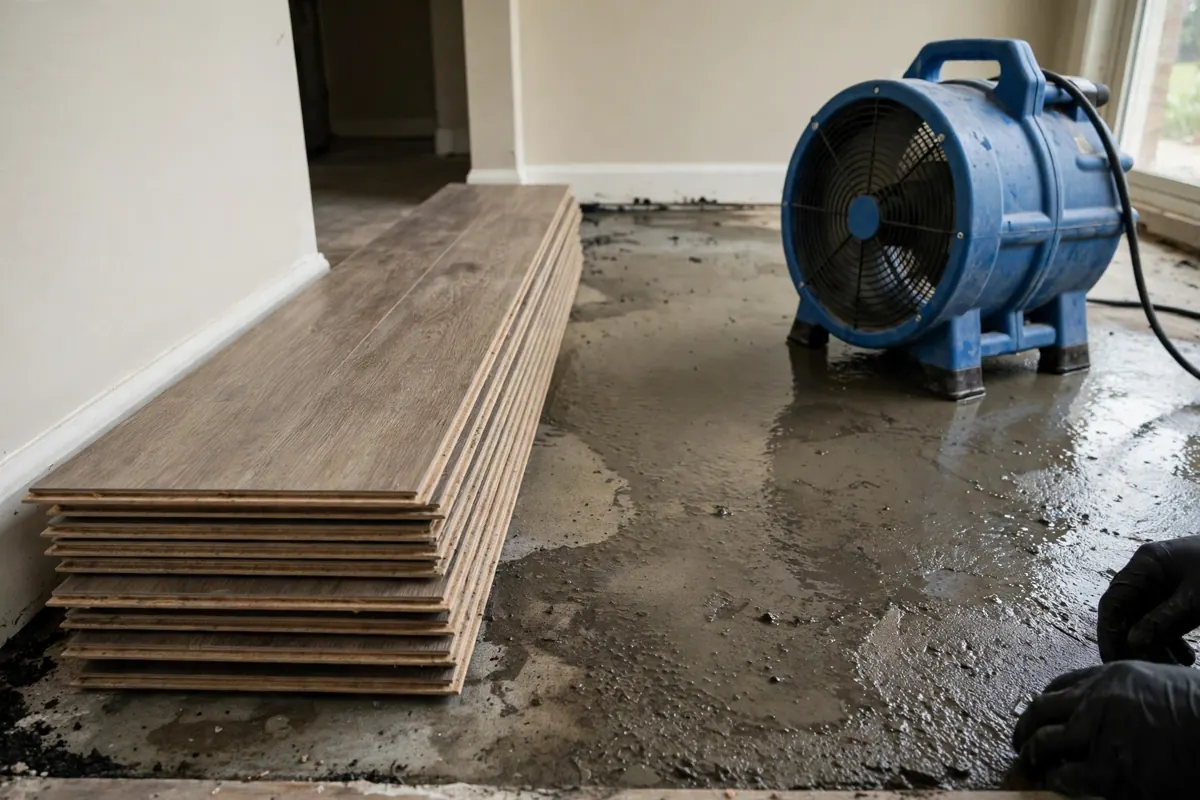
Air movers push air across the exposed slab and the edges of the flooring. Dehumidifiers pull the released moisture out of the air so the slab can keep giving it up. Floor drying mats can draw moisture from under some floors that stay in place.
Read daily at the same test points
Marked spots are read every visit, so the numbers compare across days at the same place. A reading that stops falling means water is still hiding or the setup has to change.
Reach the drying goal
The job is done when each material reaches its drying goal, set from the dry reference in your own home. A room that feels comfortable doesn’t end the job. The log shows the trend to that point.
Hand over the record
You get the log, the map, the photos and the final readings for the areas tested. The drying log records moisture at the locations tested. Before new flooring goes down, the installer verifies slab moisture using the method and limits required for the selected flooring system. ASTM F2170, which measures relative humidity inside the concrete, is one such method. We don’t install flooring.
Our structural drying and dehumidification page explains the equipment and the daily readings in more detail.
Who does what after a slab leak?
The plumber finds and fixes the pipe, we dry what the water reached, and other trades handle structure and new floors. Several jobs get blended together, and each has its own trade:
| Job | Who does it | When |
|---|---|---|
| Locating the leak in the pipe | A plumber or leak detection specialist | First, with listening equipment and a pressure test |
| Repairing or rerouting the line | A plumber | Before any drying starts |
| Drying the slab, wall bases and flooring, with a readings record | Us | After the plumber confirms the repair |
| Judging cracks or slab movement | A structural engineer | Only if there are structural signs |
| Installing new flooring | A flooring contractor | After the slab passes its moisture test |
| Deciding what is covered | Your insurer | Based on your policy and the documents |
Many people need the plumber, then us, then a flooring contractor, in that order.
What are the plumber’s repair options?
The plumber locates the leak and chooses the repair method, and the choice is the plumber’s. We list the usual options so you know what to expect. We don’t offer, schedule or recommend any of them for a specific house.
Spot repair through the slab. The slab is opened over the leak, that section is fixed, and the concrete is patched. This is the most disruptive for the floors above.
Rerouting. The failed line is abandoned and a new one runs through the walls or attic.
Tunneling. The plumber digs in from outside so finished floors stay intact.
Pipe lining. Some lining or coating systems exist, and the plumber decides whether one fits your pipe.
The choice depends on how many leaks there are, how old the pipe is, where the leak sits and what flooring is above it. Each method leaves the floors in a different state, which is why the drying plan comes after it.
Why is slab leak water damage wider than it looks?
The damage runs wider than the spot you see because of time, wicking and trapping. A pinhole leak can run for weeks before a bill or a stain gives it away. Three things then work against you:
Time. Water has weeks to spread before anyone knows. By the first sign, the slab and the wall bases are often already soaked.
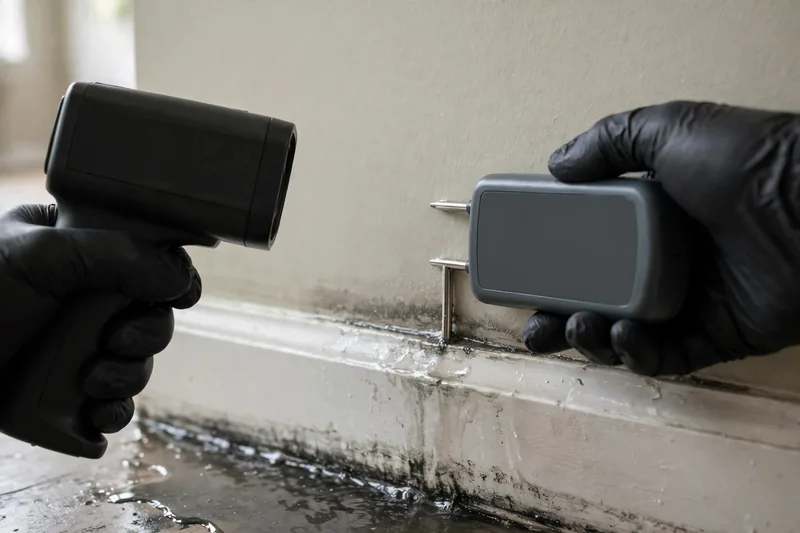
Wicking. Concrete is porous and releases moisture slowly. Water moves through it by capillary action and climbs into the bottom of the walls, so a wall can read wet higher than the visible mark.
Trapping. A non-porous floor covering seals the top of the slab. Water can’t evaporate upward, so it stays in the concrete and breaks down the adhesive under vinyl and wood-look floors.
A slab in a slab-on-grade home has no open space below it to dry into. It gives up moisture from the top, slowly. That is why a floor can feel dry while the slab under it is still wet.
Water from a supply line starts as clean water. As it sits and passes through soil and materials it can pick up contamination, so we read and record. S500, the water damage restoration standard, uses that classification system.
Where does the water hide?
It hides in the lower walls, behind baseboards, under flooring and in the hollow under cabinets.
| Where | Why it hides | How we read it |
|---|---|---|
| Lower drywall and wall base | It wicks water up from the slab line | Pinless sweeps and pin readings from the base upward |
| Behind baseboards | Trim traps water against the wall and softens when soaked | Trim sections lift for readings and drying |
| Under hard flooring | Water spreads sideways under tile, laminate and engineered wood | Sweeps across the floor against the dry reference |
| Under vinyl plank | The plank resists water while the slab stays wet | Readings at the seams and at the wall base |
| Cabinet toe-kick void | The hollow under cabinets holds water unseen against the slab | A look and a reading in the void |
| Carpet pad | Pads hold water under carpet that feels dry | Readings through the carpet, pad checked at lifted edges |
How do I know a leak has reached my floors and walls?
A rising water bill, a warm spot on the floor or the sound of running water points to a leak, and a damp patch that never dries means the water reached your materials. No single sign confirms a slab leak. A plumber confirms it, and we don’t locate leaks.
What are the early signs?
A warm spot on the floor. A hot water line leak heats the concrete above it. This is the most specific single sign. A cold line leak never produces one.
The sound of running water. You hear it with every fixture and appliance off.
A bill that rises and stays up. The new level holds with no change in how you use water.
Low water pressure. This is a supporting sign. It never confirms anything alone.
How does a water meter test work?
Turn off every fixture and appliance, then watch the meter’s leak indicator, or read the meter twice a couple of hours apart. If the numbers move with everything off, water is escaping somewhere. The test shows that water is escaping, and the plumber finds where.
What are the late signs?
A damp patch that never dries. Moisture has reached the materials. This is where the drying conversation starts.
A floor that has changed. Boards cup, buckle or lift at the seams, or planks gap. That is the surface evidence of trapped water.
What should I do first?
Shut off the main water valve and call a plumber. Leak location and repair are the plumber’s work. Call us after the pipe is fixed, so the drying starts against a dry supply line.
What happens to each floor type after a slab leak?
Each floor reacts differently, and the readings decide what stays and what comes up. Here is the usual outcome by material:
| Floor | What the water does | What drying can do |
|---|---|---|
| Solid hardwood | Cups, crowns, gaps or buckles as boards take water from below | Often dryable if caught early. Boards that have buckled usually need replacing |
| Engineered wood | Layers swell and edges lift. It is judged like hardwood, by readings and board shape | Dried in place when readings allow, lifted when they don’t |
| Laminate | Swells and separates at the seams | Swollen laminate doesn’t recover and is usually replaced |
| Luxury vinyl plank | The plank resists water while the slab under it stays wet | Planks may have to lift so the slab can dry |
| Tile and grout | Often survives. Grout is not a seal | The layer beneath is read and dried |
| Carpet and pad | The pad holds water and usually comes out after long wetting | The carpet is judged by the readings |
When does flooring have to come up?
Flooring comes up when the readings show water trapped under it, or when the material has failed. A floor that feels dry can sit on a wet slab.
Sections lift only where readings require it, and each piece is recorded.
This is removal for drying only. Putting new flooring down belongs to a flooring contractor.
Some floating floors can lift in sections. Glued floors and nailed hardwood are harder, and we tell you before anything comes up.
How long does a slab take to dry?
A slab takes as long as the readings say, and it dries more slowly than the walls above it. Concrete releases moisture slowly, so the slab is usually the last material to reach its drying goal.
We don’t give a day count, because the job ends when your readings reach your drying goals. Four things move the timeline:
- How long the leak ran before it was found, which differs in every home
- How much water the slab and walls took in
- Whether a floor covering is sealing the top of the slab
- The humidity of the air in the house
The EPA’s guidance for clean water damage in schools and commercial buildings is to dry wet materials within 24 to 48 hours to prevent mold growth. That is guidance for early response. With a slab leak, the leak often ran unseen for some time, so drying as soon as the pipe is stopped keeps the moisture from reaching further. Mold testing and removal belong to a company licensed by Texas, and we don’t do either.
Does a slab leak mean foundation damage?
A slab leak is a plumbing problem first, and a structural question only sometimes. Most slab leaks need no structural work. The leak and the foundation are two separate diagnoses, made by two different trades.
A leak that runs a long time can saturate the soil under the slab and wash some of it out. That can lead to settlement, which can look like foundation failure. North Texas clay soil swells and shrinks with moisture, which is why leak and foundation questions get mixed up in this area.
Here is how the questions split:
Water first. We dry the slab, wall bases and flooring and record the readings.
Structure second. If you see new cracks, sticking doors or a floor that has shifted, a structural engineer measures the slab.
If the engineer finds a problem. A foundation company handles any structural work.
We don’t diagnose or repair foundations. A dry slab with readings on paper helps the engineer and the plumber do their parts.
Does insurance cover slab leak water damage?
It depends on your policy, and insurers often judge the pieces separately: the water damage, the access to the pipe and the pipe repair itself. Ask your insurer about each one, in writing if you can.
The water damage. Many policies address sudden and accidental discharge of water, and the damage it does to flooring, wall bases and cabinets. Your policy sets the terms.
Access to the pipe and the pipe repair. These are often treated differently from the water damage. Ask whether opening the slab or walls to reach the pipe is covered, and whether the pipe repair is covered at all.
Sudden versus gradual. Insurers look at whether the damage was sudden and accidental or came from gradual leakage. Texas Department of Insurance guidance draws that line. A slab leak that ran a long time can be argued either way, so the plumber’s report and the repair invoice matter.
Our map, drying log and photos add to that file. Adjusters work from the plumber’s documentation, the photos and the readings record. We provide documents and we don’t decide coverage. For questions about your rights, the Texas Department of Insurance is a good place to start.
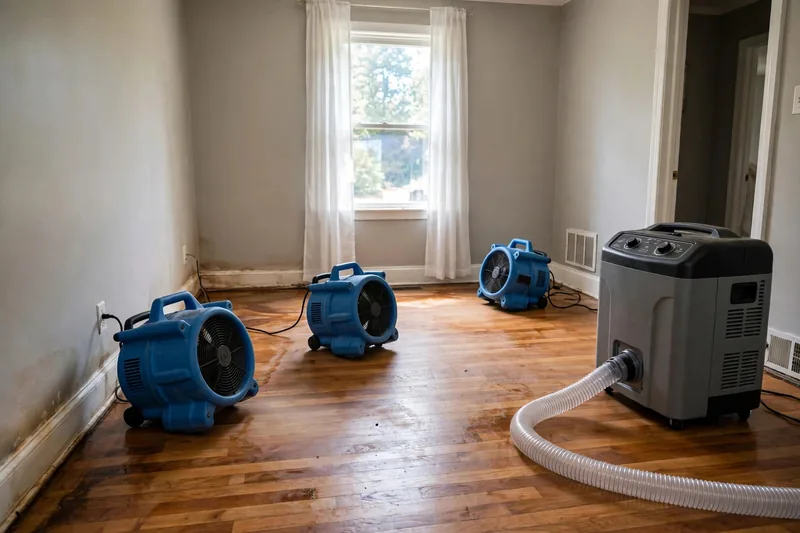
Slab leak water damage drying in Rowlett
We take calls for Slab Leak Water Damage Drying in Rowlett ZIP codes 75088 and 75089, from Downtown Rowlett near Main Street and City Hall to the homes along Lakeview Parkway, Dalrock Road and Miller Road, and the properties near Lake Ray Hubbard. Call to confirm your address, and to check coverage if you are in a nearby city.
Many Rowlett homes sit on a concrete slab, so the water lines run in or under the floor. When one fails, the water spreads flat across the slab, wicks into the wall bases and runs under hard flooring to rooms far from the leak. That is why we map the whole ground floor and not one spot. If the water is coming from the city main or the street, call Rowlett Public Works at (972) 412 6287 on weekdays, or (972) 412 6201 after hours for water and sewer emergencies.
Leak stopped and floors still wet? Call (555) 247-0199.

What can you expect when you call?
- Questions first. We ask when the leak was found, who fixed it and what flooring you have.
- The plumber’s confirmation. We ask that the repair is done, so the drying isn’t working against a live line.
- A visit with a record. You get the map, the drying log and the photos.
- Plain advice. We tell you when you need an engineer or a flooring contractor, and what we don’t do.
Questions people ask about slab leak drying
Can I stay in my home during drying?
Most people do. The equipment runs all day and is loud, so many people pick one quiet room to sleep in. We keep cords and machines out of walkways, and we tell you which rooms will have lifted floors or open wall bases before the work starts.
Will you find the leak?
No. Finding the leak in the pipe is the plumber’s work, done with listening equipment and a pressure test. We start after the repair. Our moisture map shows what the water did to the floors and walls. The plumber’s work shows where the pipe failed.
Do I have to rip up my flooring?
Not always. The readings decide. Tile often stays, and a floor that reads dry stays. A floor sitting on a wet slab or a failed adhesive has to lift so the slab can dry. We tell you what the readings show before anything comes up.
Can new flooring go down as soon as the floor feels dry?
No. A slab can feel dry on top and still hold moisture inside. Before new flooring goes down, the installer verifies slab moisture using the method and limits required for the selected flooring system, often in-situ relative humidity testing (ASTM F2170). We hand over our drying log for that step.
Will the water come back after drying?
Not if the plumber’s repair holds. Drying removes what is already in the slab and walls. If readings rise again after the job, that points back to the pipe, and the plumber should look at it again. That is one reason we keep a dated record.
Call now for Slab Leak Water Damage Drying in Rowlett
Call (555) 247-0199 for slab leak water damage drying in Rowlett. Call to confirm service availability for your address.
Call (555) 247-0199Sources
(last updated November 2026)
- U.S. EPA: Water damage table from Mold Remediation in Schools and Commercial Buildings
- ANSI/IICRC S500: water damage restoration standard, named for the water classification and the dry reference
- ASTM F2170: in-situ relative humidity testing of concrete slabs, named as one test method
- RestoreAdvisor: slab leak guide (definition, slab-on-grade scope, how long leaks run unseen)
- Texas Department of Insurance: tdi.texas.gov
- Slab Leak Sleuth and Ringemann Plumbing: slab leak versus foundation problem
- EngineerFix: flooring moisture guides
- Staggs Plumbing (Dallas Fort Worth): the usual repair methods
- City of Rowlett: Public Works