Structural Drying & Dehumidification in Rowlett, TX
Is the water out but the walls, floors and framing still wet? Structural drying pulls the moisture that soaked into the building back out with air movers and dehumidifiers. We keep going until each material reaches its drying goal.
Pumps get the puddles out. They don’t get out the water inside drywall, framing, subfloors and concrete. We seal off the wet area, set the equipment, check the materials every day and stop when they read dry. We cover ZIP codes 75088 and 75089 in Rowlett. Call to confirm service for your address.
Request Structural Drying & Dehumidification in Rowlett: (555) 247-0199. If there is still standing water, start with our water extraction page.
How do I know my building is still wet after the water is gone?
A surface that looks and feels dry can still hold water inside. Drywall, framing, subfloors and concrete release moisture slowly, and the first days after a leak or storm are when most people decide the job is finished. These are the signs it is not:
- Paint that bubbles, peels or stains on a wall or ceiling
- Baseboards, door trim or cabinet bases that swell, lift or soften
- Floors that cup, buckle or feel spongy
- Doors and windows that start to stick
- A musty smell that stays after the cleanup
- Indoor air that feels heavy, or windows that fog on the inside
A basic hygrometer shows the humidity of a room. It can’t show what is inside a wall, which is why a meter reading on the material itself is the only real answer. A musty smell also tells you moisture is still around. If mold is already growing, that is treated by a company licensed by Texas. Drying is moisture control, which is a separate job from mold remediation.
These signs point to the same problem. People go through the cleanup once, then deal with a cupped floor or a stained wall a few weeks later. Drying the structure properly the first time is how you avoid the second round. Whether the water came from a pipe, a roof or an appliance, the Structural Drying & Dehumidification work is the same.
What does structural drying look like step by step?
It runs in seven steps: set the drying goal, plan, seal, set the equipment, run it, read daily and confirm dry. Each step has a reason, and skipping one is how floors cup and walls stay wet.
Set the drying goal
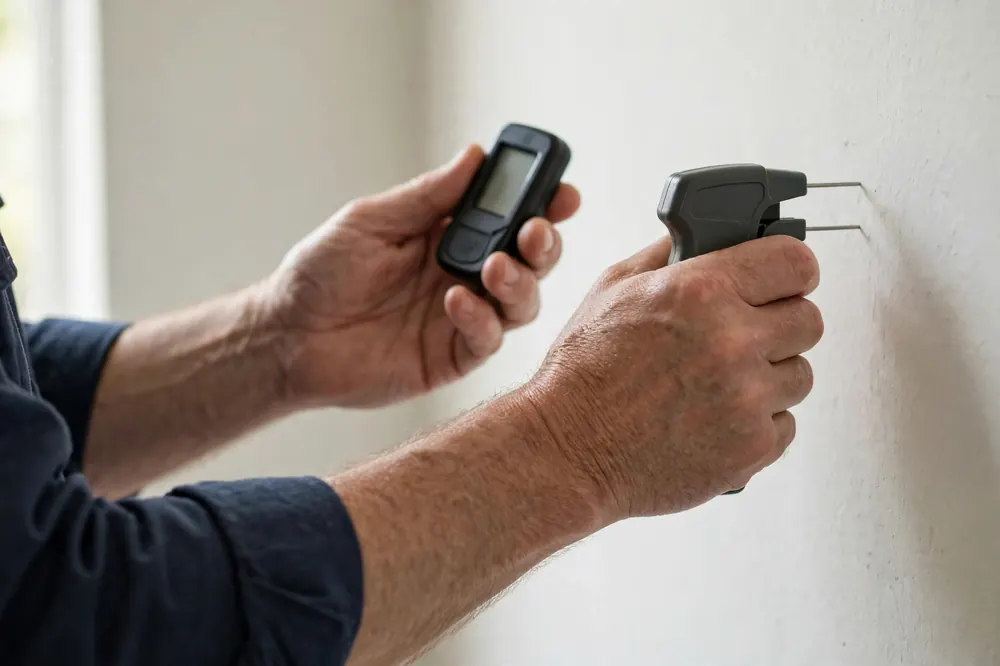
Where we can, we read comparable materials in a dry, unaffected part of the building. Those numbers set the drying goal for each material. We then read the wet materials with a pin meter, which reads inside the material, and a pinless meter, which scans quickly. A thermal camera can help show temperature patterns of wet areas during the job, and the meter confirms them.
Call the class and plan
We decide how much water went into the materials and which equipment fits. You hear the plan before the work starts.
Build the chamber
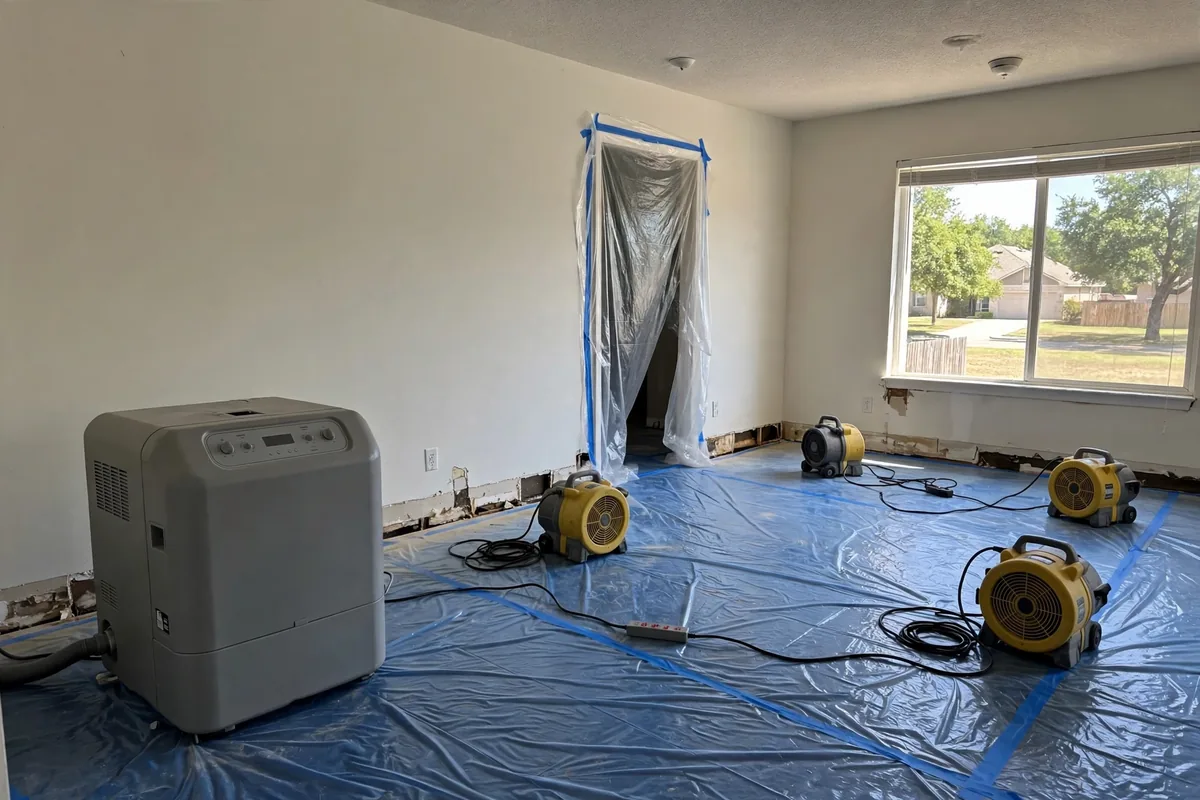
Barriers and closed doors seal the wet area. Dusty or contaminated areas get an air scrubber.
Set the equipment
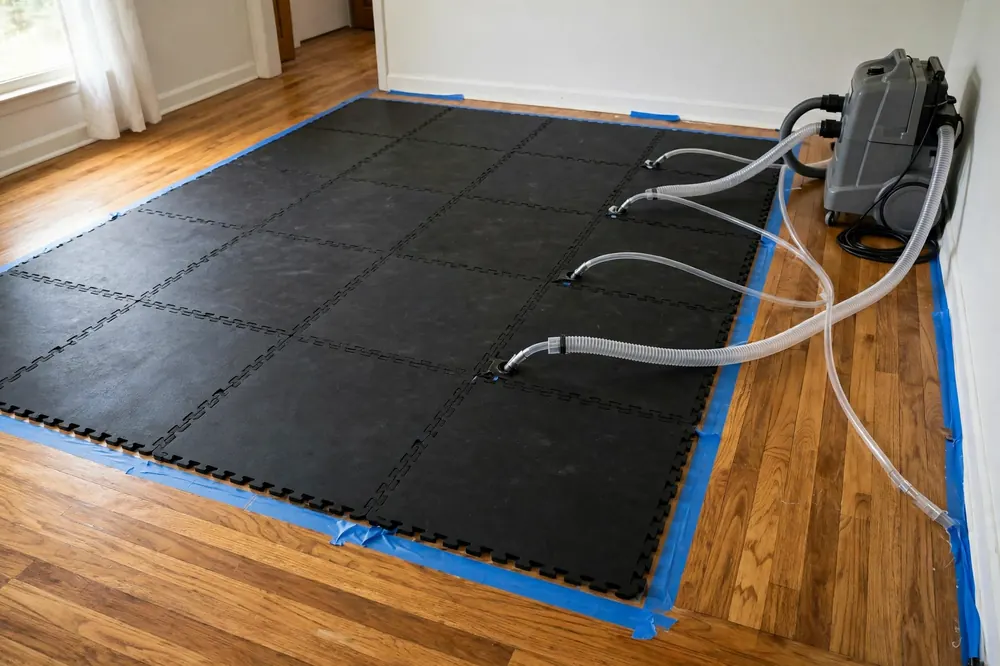
Air movers go across wet surfaces. Dehumidifiers go where they can pull the moisture back out. Wall cavities are assessed first. Where drying in place suits the wall and the readings show water, we open small holes at the base, and wet hardwood gets a mat or panel system where it makes sense.
Run it
The equipment runs until the readings say it can stop. Turning it off at night pauses the drying.
Read every day
A thermo-hygrometer gives temperature and humidity, which we turn into grains per pound. The meters give material readings. We adjust the equipment from what the numbers say.
Confirm dry and hand over
When each affected material has reached its drying goal, the equipment comes out and you get the drying log. Rebuilding is a separate trade.
For the method of finding the water before drying starts, see our moisture detection and mapping page.
What is structural drying, and how is it different from water extraction?
Structural drying is the removal of moisture that soaked into a building’s materials after the standing water is gone, followed by readings that prove the materials are dry. Water extraction takes out the liquid. Structural drying takes out what is left inside walls, floors, framing and concrete. They are two jobs, and drying is the one that protects the building from mold and warping.
You will hear a few names for this work. Water mitigation is the whole emergency job, from pumping to drying. Some companies call the drying part water mitigation drying. Restoration is the rebuilding that comes after. The industry also has a name for the method itself: applied structural drying, which means drying a structure in place instead of tearing it out. We name it so you can look it up. We don’t claim it as our certification.
Timing matters. The EPA’s guidance for schools and commercial buildings covers response to clean water damage within 24 to 48 hours to prevent mold growth, and the same logic applies to a house. The sooner the wet materials are on a drying plan, the better the odds of drying them in place.
What is left in the building after the water is pumped out?
Water that soaked in stays in. It sits inside materials that look fine on the surface. A few places it hides:
- Drywall, which wicks water upward well past the visible line
- The wall cavity behind it, where wet insulation holds moisture against the framing
- Baseboards, which trap moisture at the base of the wall
- The void under kitchen cabinet toe kicks
- Subfloor and the concrete slab under it
- Bound water, which is moisture held inside the material itself and is the slow part of any drying job
Where does structural drying end?
It ends when the materials are dry and documented. We don’t rebuild. Cutting and replacing drywall, paint, trim and flooring belong to a contractor. Permits depend on the repair work, not the drying. If rebuilding changes framing or structure, ask the City of Rowlett’s building department what is required before repairs start. Our work hands you a dry building and a drying log, and the next trade takes it from there.
Extraction, mitigation and restoration: who does what?
They are three stages of one loss, and different people often handle each.
| Stage | What happens | Who |
|---|---|---|
| Water extraction | Pumps and extractors remove standing water | Us, or the crew that arrived first |
| Structural drying (water mitigation drying) | Air movers and dehumidifiers dry what soaked in, until each material reaches its drying goal | Us, on this page |
| Restoration and rebuild | Drywall, paint, trim and flooring are repaired or replaced | A contractor |
Water mitigation covers the first two stages together. Restoration is the third. A loss can be extracted well and still go wrong if stage two is skipped.
How does dehumidification dry a wall or a floor?
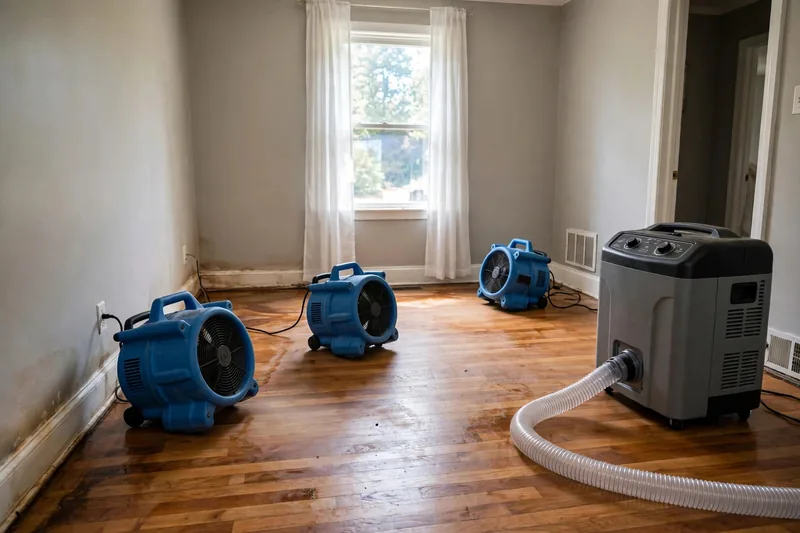
Dehumidification pulls water vapor out of the air so wet materials can keep releasing their moisture. Wet drywall or wood gives up moisture only while the air around it is drier than the material. Air movers push dry air across the surface, and the dehumidifier removes the water that air picks up. Take away either one and the drying slows down or stalls. So dehumidification services are built around machines working as a pair.
The direction rule behind all of it is vapor pressure. Moisture moves from wet material into air only while the material holds more vapor pressure than the air. Warmth raises it, which is why directed heat is part of some drying setups. Airflow speeds up evaporation. The dehumidifier keeps the air dry enough that evaporation can continue. When evaporation outruns removal, the room fills with moisture and drying stalls. A good plan keeps the two in balance.
Why can’t regular fans dry a house?
Household fans move air, but they don’t remove any moisture from it. Without a dehumidifier, that humid air just circulates, and the moisture settles on other surfaces such as walls, ceilings and furniture. Fans are a fine start for a damp towel. For a soaked wall or floor, the water has nowhere to go.
What are grains per pound?
Grains per pound, or GPP, is the true measure of how much water is in the air. One pound of water equals 7,000 grains. Relative humidity, or RH, is only a percentage of what the air could hold at its current temperature, so the same RH can mean very different amounts of water. Here is an example from a published psychrometrics guide:
- Air at 70 degrees F and 50% RH holds about 54 grains per pound.
- Air at 90 degrees F and 50% RH holds about 106 grains per pound.
Those are worked examples, not readings from a Rowlett home. A technician watches grains, not RH alone. Psychrometrics is the science of air and moisture, and the drying plan runs on it. We also compare the room air with the air coming out of the dehumidifier. The gap between them is called grain depression, and it shows the machine is really pulling water out. Dew point, the temperature at which air gives up its moisture as condensation, matters too, because cold surfaces can collect it.
Why do you seal off the wet area?
A sealed drying chamber dries the wet materials instead of the whole house. Plastic barriers and closed doors keep the equipment working on the wet area only. Sometimes plastic tenting goes over a floor or a corner to shrink the space even more. A smaller space dries faster, and the dry rooms stay dry. Where the air is dusty or the water was contaminated, a HEPA air scrubber filters the air inside the chamber during the work.
Why don’t open windows help in a Texas summer?
Outdoor air in humid weather can be wetter than the air in the room being dried. Opening a window can pull moisture in instead of out. One published worked example found humid summer air carrying noticeably more grains per pound than the room it was meant to dry. We compare indoor and outdoor conditions before using outside air, and until we say otherwise you should keep doors and windows shut once the equipment is running.
What are drying classes 1 to 4?
A drying class describes how much moisture the affected materials hold and how hard it may be to release, not how dirty the water was. The S500 water damage standard sorts losses into Class 1 through Class 4. A higher class means more water in more materials, and usually more equipment and more days. Water category, which is about contamination, is a separate label set on the extraction side. Class is about the evaporation load. Water damage drying always begins with this call.
| Class | How much water | What is usually wet | Drying outlook |
|---|---|---|---|
| Class 1 | Least | Part of a room, low absorption materials, little or no wet carpet | Fastest |
| Class 2 | Larger | A whole room of carpet and pad, moisture in walls and structural materials | Moderate |
| Class 3 | Greatest | The most moisture, with ceilings, walls, insulation, carpet, pad and subfloor soaked | Longer, with more equipment |
| Class 4 | Deep in dense materials | Hardwood, plaster, brick, concrete and stone, which hold water in tightly | Longest, with specialty drying methods |
The crew uses the class to plan the drying setup. S500 is a classification standard. We name it as the system and don’t claim it as our certification.
What should I do while the drying equipment is running?
Leave the equipment alone, keep the area closed and call us with questions. The setup is planned for your building, and small changes can stall it. A few simple rules:
- Keep doors and windows closed in the drying area.
- Don’t unplug, move or turn off the machines. Turning them off at night pauses the drying.
- Keep cords and hoses clear of walkways, and keep children and pets away from the equipment.
- If a breaker trips or a machine stops, call us. Don’t keep resetting it.
- Don’t stack boxes or push furniture against wet walls. Air has to reach them.
- Tell us if you see a new stain, a new smell or water coming back.
Can I stay in the building during drying? It depends on the water category, the size of the loss and which rooms are inside the drying chamber. Many people stay in the dry parts of a building. The equipment is loud, and it runs for days. We tell you what is workable after we look at the job.
Does the source have to be fixed first? Yes. If a pipe is still leaking or a roof is still open, drying is wasted effort. A plumber or a roofer stops the source, and then the drying starts.
What do you dry? Walls, floors, ceilings and slab
We dry whatever the water soaked: drywall, wall cavities, framing, subfloors, concrete slabs, ceilings and hardwood floors. Most of it gets dried in place. Some of it can’t be saved, and we say so early.
| Material | What water does to it | How it is dried |
|---|---|---|
| Drywall | Wicks upward past the visible line | Metered, dried in place where possible, cut if it can’t dry |
| Wall cavity and insulation | Hides water against the framing | Dry air pushed in through small holes at the wall base |
| Framing and studs | Hold moisture longer than the surface | Dried until they reach their drying goal before walls close |
| Subfloor over a slab | Traps water between layers | Dried from the top down with airflow and dehumidifiers |
| Concrete slab | Dense and slow to release moisture | Long, patient drying, often with desiccant dehumidifiers |
| Hardwood floor | Swells and cups | Mat or panel system, if it can be saved |
| Ceiling and insulation | Soak first when water comes from above | Metered, opened where needed, dried in place where possible |
How does wall cavity drying work?
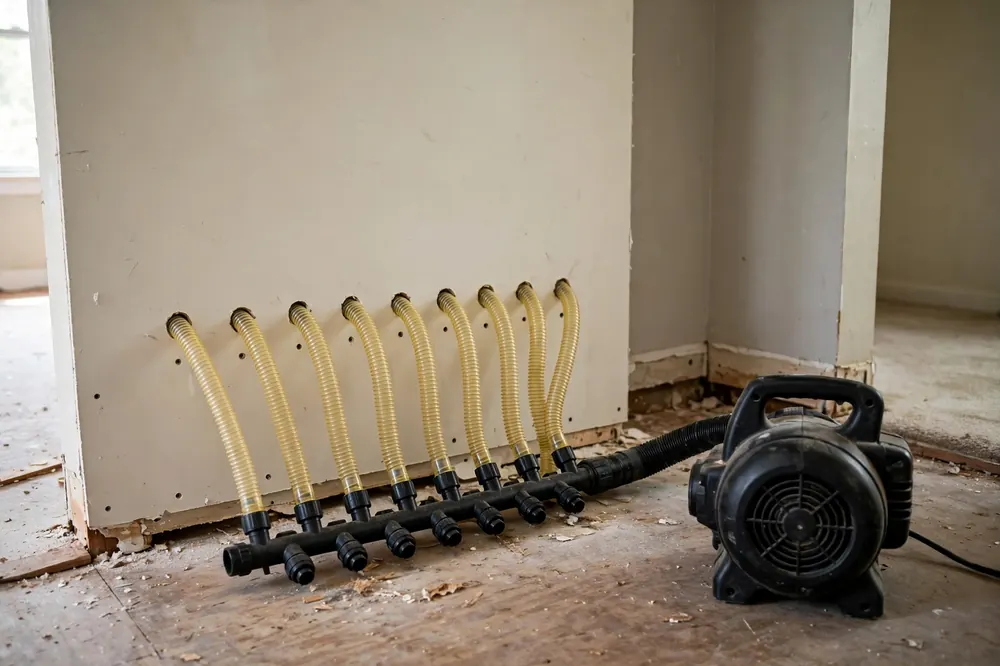
We assess the cavity, the insulation and any contamination first. If the wall can be dried in place, we drill small holes at the base, usually behind the baseboard, and push dry air into the cavity. Hoses on a manifold send air through the holes, so drywall and framing dry in place instead of the wall coming down. The baseboard goes back over the holes. This wall cavity drying often saves the wall. Soaked insulation or contamination can still mean material has to come out, and we tell you which before we cut.
Kitchen cabinets get the same care. A cabinet base hides a void that holds water out of sight, so we check the toe kick space.
What about floors and the slab in a Rowlett home?
Many North Texas homes sit on a concrete slab. If yours does, there is no space under the floor to work from, so floor drying goes from the top down. The subfloor and the concrete have to dry through their upper surface, with airflow and dehumidifiers in the room. The slab itself is dense and among the slowest materials to dry. Desiccant machines are often used on it. If the water came from a leak under the slab, our slab leak water damage drying page covers that case.
What about ceilings and attic water?
Water from above soaks ceilings, insulation, walls and floors on its way down, so we check the whole path. An attic line or an upstairs fixture can wet three levels of a building. We follow the water from the ceiling to the floor with the meter and dry each layer.
What about large and commercial buildings?
Big buildings are dried in zones. Building drying services for a warehouse, shop or office use larger equipment and a plan that decides which zones dry first, which stay open and which are work areas. Desiccant units come out for large losses and dense materials. Call with the square footage and the number of floors or suites, and we confirm what we can take on.
What drying systems and equipment does a job use?
A drying job uses a small set of machines and systems, each with one purpose. We pick from this list based on the class, the materials and the room.
| Equipment or system | What it does | Where it is used |
|---|---|---|
| Air mover | A fan built for drying. It pushes air across wet surfaces to speed up evaporation. Centrifugal and axial types are both common | Floors, walls and ceilings |
| LGR dehumidifier | Removes water from the air and keeps working as the air gets drier | Most rooms in most homes |
| Desiccant dehumidifier | Makes very dry air with a silica gel wheel, and works in the cold | Dense materials, cold rooms and large losses |
| Containment barrier | Plastic sheeting and closed doors that seal the wet area | Around every drying chamber |
| Tenting | Plastic over a floor or corner to shrink the chamber to the wet material itself | Floors, cabinets and corners |
| Wall cavity drying system | Hoses on a manifold that push dry air into wall cavities through small holes | Wet walls behind baseboards |
| Floor mat system | Sealed mats that pull moisture through the seams of wet hardwood under negative pressure | Hardwood and some engineered wood |
| Injection drying panels | Panels that draw moisture from inside a floor assembly, placed only over wet flooring | Floors with trapped moisture |
| HEPA air scrubber | Filters the air inside the chamber | Dusty or contaminated areas |
| Meters and a thermo-hygrometer | Read materials and the air | Every job, every day |
We don’t list brands, machine counts or ratings, because the right set depends on your building. Call and we confirm what your job needs.
Can hardwood floors be dried and saved?
Sometimes. Hardwood can often be dried in place if drying starts soon enough, but not every floor can be saved. Solid hardwood over a wood subfloor has the strongest odds. Engineered wood, laminate and hardwood over concrete are harder. We tell you what we see before the equipment goes in, because no honest company can promise a floor.
Hardwood floor drying uses sealed mats or panels laid over the wet boards. Liquid water gets extracted first. Then the system pulls moisture up through the board seams and out of the subfloor under negative pressure. The maker’s instructions for one mat system say wood floor drying needs very dry air and recommends LGR or desiccant dehumidifiers running alongside. Panels go only over wet flooring, because vacuum on dry wood can over-dry it. The goal is not to dry the floor as far as it will go. The goal is to reduce cupping and bring readings back into range. Published guides put a typical mat job at two to four days.
If you have been searching for a hardwood floor dehumidifier, here is the plain answer. A single household unit in a wet room is a start. It doesn’t seal the area, push air across the boards or give you readings to know when it is done.
Why does a hardwood floor cup?
A floor cups when the underside of the boards is wetter than the top. Wood is hygroscopic, which means it takes on and gives off moisture to match the air around it. The wet underside swells more than the dry top, and the board edges lift. Equilibrium moisture content is the level a board settles at for the air it lives in, and it is why a floor has to dry evenly, not just fast.
Don’t sand a cupped floor while it is still wet. Sanding removes the raised edges, then the floor crowns as it finishes drying. The National Wood Flooring Association has warned against sanding while readings still show a moisture imbalance. Sanding and refinishing are a flooring trade’s work, not ours.
Which floors often cannot be saved?
Engineered wood and laminate often cannot be dried once their layers separate. Hardwood over concrete is also harder to dry because the slab keeps feeding moisture up. When a floor is past saving, we say so, tell you what we saw in the readings, and dry the subfloor so the new floor goes down on dry ground.
LGR or desiccant: which dehumidifier does the job need?
Most homes get LGR dehumidifiers. Desiccant units come out for cold rooms, dense materials and big losses. LGR stands for low grain refrigerant. A desiccant unit uses a silica gel wheel to make the driest air. The right choice depends on the room temperature, the materials and the size of the loss. The people who set up dehumidification services should be able to tell you why they picked one.
| Type | How it works | Strongest for | Limit |
|---|---|---|---|
| LGR | Chills air so water condenses out, with pre-cooling | Most Class 1 and 2 losses, many Class 3, normal room temperatures (roughly 70 to 90 degrees F) | Loses efficiency as the air gets very dry, around 34 grains per pound |
| Desiccant | A silica gel wheel absorbs moisture chemically | Cold rooms, dense materials like hardwood, plaster and concrete, and very large losses | Larger setup, so it is used where it is needed |
| Conventional refrigerant | The older, standard refrigerant design | Light jobs | Loses efficiency as air dries, which is why LGR is preferred on a drying job |
We don’t sell or rent machines. We use the right ones for your job and take them with us when the readings say dry.
How do you know the building is dry?
The job ends when the affected materials reach their drying goal, not on a set day. Where we can, we take readings from comparable unaffected materials at the start and use them to set the goal. We read the affected materials every day and check whether each one has reached it.
What is the dry standard?
The dry standard is the reference: readings from comparable unaffected materials, where available. The drying goal is the target we set for each affected material from that reference. Drywall, framing and wood each get their own number. Looks can mislead. The LSU AgCenter, cited in Restoration & Remediation Magazine, says appearance and elapsed time can’t tell you a material is dry. A wall can look fine and feel dry and still be wet inside the cavity.
What goes in the drying log?
The log is the written record of the job: the drying goals, every day’s readings and the equipment changes. It shows wet at the start, drier each day, then at the goal. If one area stops falling, that is useful. It means water is hiding in a spot we have not reached yet, and we change the setup or tell you a material needs to come out. You get a copy. After a covered loss, insurers often ask for photos and readings to document the drying. We provide the record. We don’t handle claims or decide coverage.
Where does this page end and moisture detection begin?
The daily readings are part of our drying job. They show whether the materials we are drying are getting there. If you need someone only to find where water is hiding, to map a building or to check a loss we are not drying, that is a separate service. See our moisture detection and mapping page.
How long does structural drying take?
Drying time depends on the materials, how far the moisture spread and what the progress readings show. Some restoration company guides, such as SERVPRO and PuroClean location pages, describe about three to five days for typical residential jobs, with dense materials taking longer. That is context, not a promise for your building. Readings decide the end date. A small loss can finish sooner. A loss in hardwood or concrete can run a week or more.
| Loss or material | Published range |
|---|---|
| Example from selected restoration guides (SERVPRO and PuroClean location pages): typical residential jobs | About 3 to 5 days |
| Hardwood with a mat system | About 2 to 4 days (ServiceMaster by Simons floor guide) |
| Concrete with desiccant drying | About 7 to 14 days (Flood Doctor, a Virginia restoration company’s FAQ) |
These ranges come from the company guides named in the table. Use them as a sense of scale, not a schedule. Drying time depends on the affected materials, the moisture levels and what the progress readings show. What changes the time:
- How much water went in, and how long it sat
- How dense the material is
- How soon drying started
- The temperature and humidity in the building
- The size of the area and the equipment on it
- Hidden moisture that shows up on day two
Our rule is simple. When each affected material reaches its drying goal, we are done, and not before.
How do I choose a structural drying company?
Ask how they set the dry standard, what they read each day and what you get at the end. Any structural drying company should be able to answer plainly. The answers tell you more than any claim on a website.
Questions to ask any company, including us:
- How do you decide when the job is done?
- Do you take readings from a dry area at the start?
- Will I get the daily readings in writing?
- What equipment do you plan to use in my building, and why?
- What happens if a floor or wall can’t be saved?
- Who handles the rebuild, and where does your work stop?
Warning signs:
- A fixed number of days promised before anyone has read the materials
- Drying with fans only
- No log, or readings you can’t see
- No mention of what might not be saved
- Pressure to sign for the rebuild before the drying is done
We answer the first five questions on this page. The rebuild is someone else’s trade, and we say so.
What do you not do?
We dry the building. We don’t rebuild it, treat mold, sell equipment or run claims. Here that means drying and documenting. A few things belong to other trades:
- Rebuilding walls, ceilings and floors belongs to a contractor.
- Mold assessment and removal belongs to a company licensed by Texas.
- Selling or renting dehumidifiers and air movers is not part of what we do.
- Standalone moisture detection, mapping and monitoring visits are covered on our moisture detection and mapping page.
- Fixing the source of the leak belongs to a plumber or a roofer.
- Coverage decisions belong to your insurer.
Some companies sell the rebuild after the drying. A structural drying company should stop once the building is dry and documented, and so do we.
Structural drying in Rowlett
We take calls for Structural Drying & Dehumidification in Rowlett ZIP codes 75088 and 75089, from Downtown Rowlett near Main Street and City Hall to the homes and businesses along Lakeview Parkway, Dalrock Road and Miller Road, and the properties near Lake Ray Hubbard. Call to confirm your address, and to check coverage if you are in a nearby city.
Rowlett’s weather works against a wet building. Summers can be humid. We compare indoor and outdoor conditions before deciding whether outside air will help, and in a humid spell the chamber stays sealed and the dehumidifiers do the work. If your home sits on a concrete slab, floors dry from the top down, as covered above. If the water is coming from the city main or the street, call Rowlett Public Works at (972) 412 6287 on weekdays, or (972) 412 6201 after hours for water and sewer emergencies. For standing water, see our water extraction page.
Is the building still wet after the water is gone? Call (555) 247-0199.
What can you expect when you call?
- Questions first. We ask where the water came from, when it happened, what has been pumped out and which rooms and materials are wet.
- Floor type. Hardwood, tile, carpet or vinyl over a slab changes the plan.
- A plan you can follow. We explain the class, the equipment and what we will read each day.
- Daily readings. You get a drying log at the end.
- Plain advice. We tell you when you need another trade, and what we don’t do.
Questions people ask about structural drying
Is structural drying covered by insurance?
It depends on your policy and what caused the water. Many property policies cover sudden and accidental water damage, and gradual leaks and neglect are usually the excluded side. Your policy and your insurer decide. For questions about coverage, the Texas Department of Insurance is a good place to start. We provide the drying log and don’t handle claims.
Do I need an insurance claim before you start?
No. You can call about a loss you plan to pay for yourself. Photos and a drying log still help if you decide to claim later. Your policy decides what is covered, and your insurer decides what it pays.
Will drying equipment raise my electric bill?
Usually, yes. Dehumidifiers and air movers draw power for several days. How much it adds depends on how many machines run, for how long and what you pay per unit, so we can’t give a number. Keep your power bill from the drying period and ask your insurer how they treat it.
How loud is the drying equipment?
Expect steady fan and motor noise for days. Air movers are fans, and dehumidifiers run compressors or heated wheels. Turning the machines down slows the drying, so we don’t recommend it. If the noise is a problem, call us and we can look at where the equipment sits and how many machines the job needs.
Call now for Structural Drying & Dehumidification in Rowlett
Keep the doors and windows closed, keep the equipment running once it is set, and call (555) 247-0199 for structural drying in Rowlett. Call to confirm service availability for your address.
Call (555) 247-0199Sources
(last updated November 2026)
- U.S. EPA: Water damage table from Mold Remediation in Schools and Commercial Buildings
- Restoration & Remediation Magazine: ANSI/IICRC S500 classes of water loss and the dry standard, with the LSU AgCenter citation
- ANSI/IICRC S500: water damage restoration standard, used here only as a classification system
- Legend Brands (Dri-Eaz) technical guidance: LGR and desiccant dehumidifiers, and the Rescue Mat System instructions
- AlorAir Restoration: psychrometrics guide with the grains per pound examples
- Wood Floor Business and the National Wood Flooring Association: hardwood cupping and sanding guidance
- Texas Department of Insurance: tdi.texas.gov
- City of Rowlett: Public Works
- Texas Department of Licensing and Regulation: Mold FAQ